
Introduction: The Value Chain Analysis Every Business Leader Needs.
You would just break down your whole business operation into the fundamental parts of the business, find out where you make value and where you are hemorrhaging cash. It is exactly what Value Chain Analysis will enable you to do.
This strategic framework, which was initially established by Michael Porter in 1985, has since become something all organizations that desire to gain competitive advantage cannot do without. As a startup founders or a corporate strategist, you can uncover those untapped opportunities by comprehending your value chain and how it can help cut costs, introduce differentiation and outwit competitors.
In this all-encompassing guide, we are going to discuss the functionality of the Value Chain Analysis, its relevance in the current competitive world and how you can use it in the present moment to change your business activities. Also you will find real-life examples, tips, and tricks that can be implemented and then examples of how successful firms have conquered their industries.
What is Value Chain Analysis?
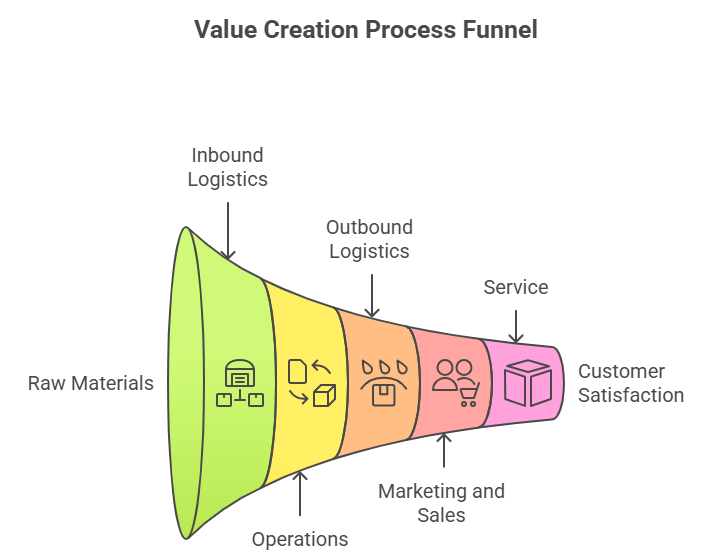
Value Chain Analysis is a strategy tool that disaggregates your business activities into primary and support functions to discover where value is created- and where it is lost. Accordingly, it charts the path through which raw materials are transformed into the production of finished goods or services to the consumers.
The model separates two types of activities:
Activities that are considered to be primary create and deliver value:
- Inbound logistics (receiving and storage of materials)
- Operations (changing the inputs into the products)
- Outbound logistics (shipment of completed goods)
- Marketing and sales (attracting and converting customers)
- Service (after sales services)
- Primary functions are supported by activities:
- Sound infrastructure (management, finance, planning)
- Human resource practice (recruiting, training, development)
- Innovation (R&D, automation of processes)
- Procurement (buying of inputs and resources)
As per Harvard Business School, firms that analyze their value chain systematically realize 23 percent profit margins as opposed to their competitors who do not.
The Importance of Value Chain Analysis to Your Business.
Value Chain Analysis is not optional in the modern hyper-competitive world. Here’s why:
Determining Cost Saving Ideas.
Analyzing the activities separately, you will identify resources wasting inefficiencies. An example of this is how Amazon has transformed its inbound logistics with advanced warehouse automation and therefore the cost of fulfillment is 40% less and faster.
Improving Competitive Differentiation.
Being able to see the places you generate unique value will enable you to redoubling the efforts on competitive advantages. The value chain at Apple makes it focus on design and user experience during its entire set of activities, which explains the high pricing beyond what the competitors can afford.
Maximizing Resource Allocation.
In addition, Value Chain Analysis shows the activities that should be given more investment and those that should be outsourced or even removed. According to McKinsey and Company research findings, when companies redistribute resources using value chain insights, ROI is enhanced by an average of 30.
Enhancing Customer Experience.
The pain points are clear when you map activities as viewed by the customer. You can then re-engineer processes in order to provide better experiences at key points of contact.
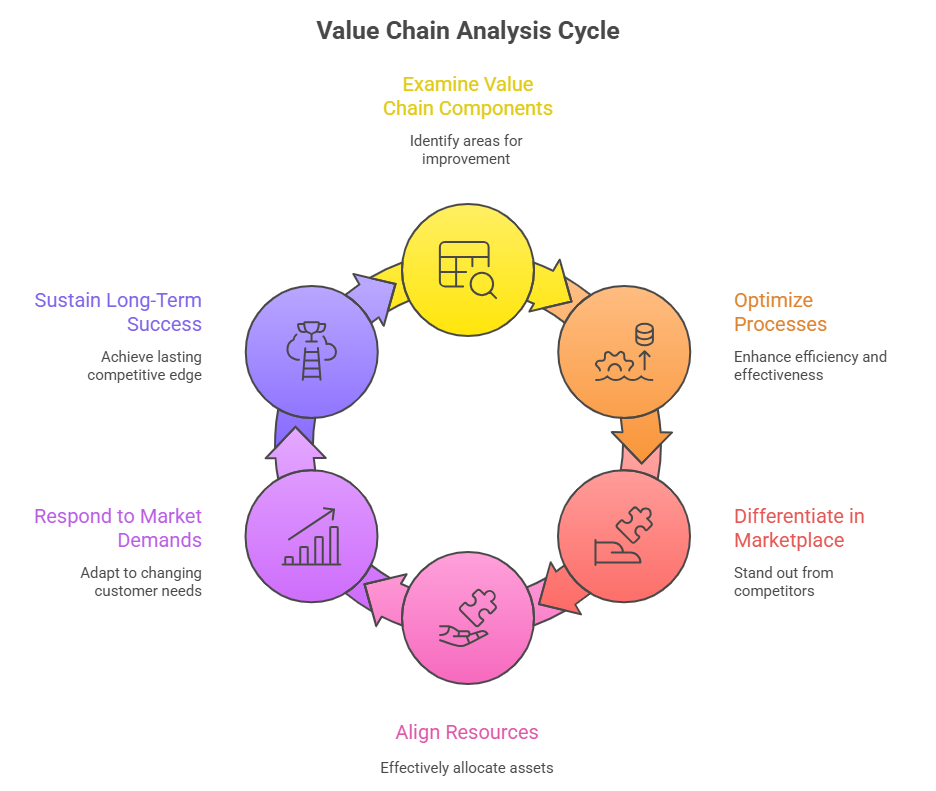
Some of the steps to be followed in order to do a value chain analysis include How to Conduct a Value Chain Analysis.
To effect Value Chain Analysis, you will have to undertake a systematic analysis of your business activities. The following is your action plan:
Step 1: Map All Business Activities.
Begin by enumerate all the activities that your organization undertakes with primary and support functions being the main categories of activities. Also, record the resources, costs and outputs of each of the activities.
Pro Tip: Involvement of cross functional teams to achieve thorough mapping. Various departments tend to engage in other activities that are invisible and they influence greatly on value creation.
Step 2: Cost and Value addition Analysis.
Secondly, calculate the costs and the value contribution of each activity in the eyes of the customer. Activities that are expensive and have low value to the customers are the best activities to optimize.
| Activity | Annual Cost | Customer Value Impact | Optimization Priority |
| Quality control | $500K | High | Medium |
| Custom packaging | $200K | Low | High |
| 24/7 support | $800K | Very High | Low |
Step 3: Determine Competitive Advantages.
Compare value chain with competitors. Where do you outperform them? Businesses such as Zara control the fast fashion industry since they are vertically aligned to enable the delivery of new designs within two weeks as opposed to six months in the industry.
Step 4: Work out Optimization Strategies.
On the basis of your analysis, develop certain strategies:
- Cost Leadership: Slim down operations in order to become the low cost supplier.
- Differentiation: Improve customers value-creating activities.
- Focus: Develop certain value chain areas to target niche markets.
Step 5: Change Implementation and Management.
Lastly, implement the changes in a systematic form, and monitor the performance indicators. Moreover, you should re-review your Value Chain Analysis every quarter because the market situation, and customer tastes and preferences are ever-changing.
Value Chain Analysis Applications.
IKEA: The Art of Cost Leadership.
IKEA has a value chain that is geared towards the lowest cost at all levels. They create flat-pack furniture (saving 60 percent of shipping fees), outsource manufacturing to cheap areas, run giant self-service warehouses and decentralize the work of assembly to the end-user. They will therefore sell their products at a price that is 30-50 less than that of the traditional furniture stores.
Starbucks: Premium Differentiation Construction.
Starbucks has a huge investment in support activities such as training employees and store atmosphere. Their value chain focuses on the third place experience rather than efficiency in operations. In addition, they also obtain high quality beans directly at farmers, and hence quality that warrant premium prices. This strategy is able to pick up profit margins of about 13 which is much higher than the industry average profit margins of 6-9 to the restaurant industry.
Dell: Direct Model Revitalization.
Dell has changed the PC industry in that they have removed retail distribution as part of their value chain. They make sales directly to the consumers instead, tailoring each order. This invention reduced stocks within inventory by nine out of ten and made designed-to-order production that rivals did not manage to duplicate throughout several years.
Possible Pitfalls to Common Value Chain Analysis.
Even seasoned strategists fail when performing Value Chain Analysis. Watch out for these pitfalls:
Ignoring Interdependencies
Actions do not exist separately. Operational changes are implemented due to changes in procurement and outbound logistics are influenced. Thus, the connections between and the impacts of the activities should be considered prior to the changes being made.
Focusing Only on Costs
Cost reduction is necessary, but it should not be given a fetish that will ruin value-creating activities. Find this balance of efficiency versus effectiveness by posing the question: What can bring real customer value?
Ignoring Digital Transformation.
Technology has caused distortion of value chain boundaries. New business models of platforms and ecosystems that would not have been easily detected by traditional analysis are empowered by digital tools. Therefore, reflect on how the digital capabilities change your value creation process.
Conducting Analysis Once
Markets change, the competitor is innovative and customers change their preferences. The analysis done in a particular state becomes outdated very fast. Nor make Value Chain Analysis a one-time strategic pursuit.
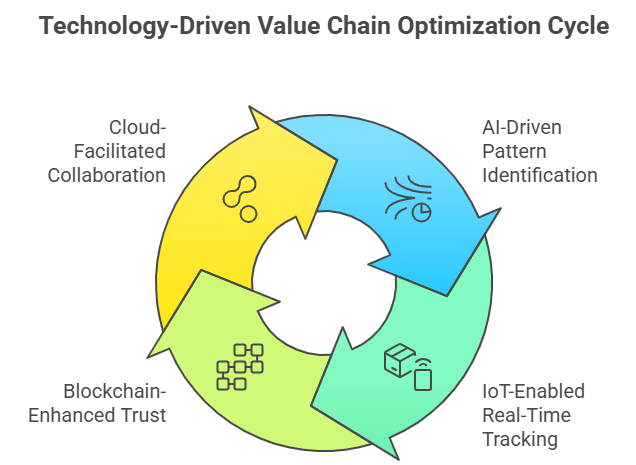
Optimizing the Value Chain by Riding on Technology.
Value Chain Analysis is shot through with modern technology:
Artificial Intelligence detects trends and optimization possibilities on large volumes of data. As an example, predictive analytics is more accurate in predicting demand, optimizing inventory at each phase of the value chain.
Internet of Things (IoT) sensors trace products at all that will give real-time visibility. Such transparency saves time and money used in losses, accelerating operations, and enhancing quality control.
Blockchain establishes unalterable history of value chain operations, which inspires consumer faith that requires transparency. Deloitte claims that blockchain penetrations into supply chains have risen by 47 per cent annually.
Cloud computing allows the value chain partners to work seamlessly all silos that existed in the past to prevent optimization initiatives are torn down.
Summary: Value Chain Analysis: How to Change Your Business.
Value Chain Analysis is still one of the most effective strategic frameworks of establishing sustainable competitive advantage. The systematic analysis of the way your organization creates value will reveal you with the opportunities that competitors miss.
To be successful in its implementation, it needs:
- Mapping out of all activities.
- Equal evaluation of cost and customer value.
- Competitive positioning strategic focus.
- Monitoring and adjusting on a regular basis.
The businesses that are successful within the current market are not necessarily the ones that offer the best products but they are the ones that have streamlined value chains that create high-quality value at an optimal rate. That is why you should begin your analysis now. Plot your activities and find areas of optimization and make alterations that change your way of competing.
What do your value chain have the most to optimize? You can post your ideas in the comments below, and go through our accompanying material on strategic planning and operational excellence to keep on your competitive advantage journey.
Ready to dive deeper? Take our free Value Chain Analysis template and become one of thousands of business leaders who have made a difference in their businesses. Get strategic information into your inbox every week. Sign up to our newsletter.