
The importance of value chain analysis to businesses today.
Suppose that you are operating a coffee shop, and you are losing money on every cup, and you can not tell where you are going wrong. Is it your supplier pricing? Your brewing process? Or your marketing strategy? This situation is enacted on small and large businesses on a daily basis.
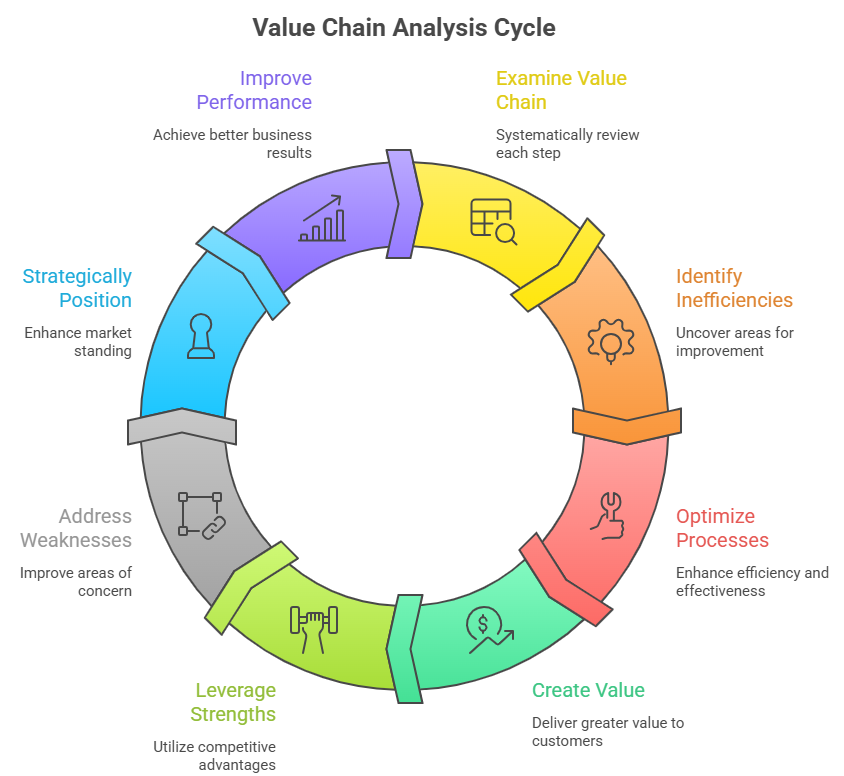
Value Chain Analysis is your solution to this puzzle. The strategic framework devised by Harvard Business School professor Michael Porter in 1985 will break down your business activities into specific activities and identify where exactly you are adding or destroying value. Additionally, it is not only useful but also a necessity to survive in the modern hyper competitive market place where you must know your value chain.
This is the ultimate guide we are about to discuss the way Value Chain Analysis functions, why it is important to your business, and most importantly how you may apply it to achieve a sustainable competitive edge. You will therefore learn practical tips and tricks that are applied by dominant businesses to ensure that they make better use of costs, quality, and work around competitors.
What Is Value Chain Analysis?
Value Chain Analysis is a strategic instrument that suggests disaggregating your business into one activity to determine the addition of value to the customer. In essence, it looks at all the steps involved in the process such as sourcing raw materials, up to the final product delivery, and it will make you realize what activities will have the greatest impact towards your competitive stance.
The framework by Porter breaks down the business activities into two:
Primary Activities (create value directly):
- Inbound Logistics
- Operations
- Outbound Logistics
- Marketing & Sales
- Service
Support (facilitate primary activities):
- Firm Infrastructure
- Human Resource Management
- Technology Development
- Procurement
Recent studies carried out by McKinsey indicate that companies that make systematic analysis of their value chains realize 15-25% noble profit margins as compared to other firms. Moreover, this framework gives us an idea of where to allocate funds to influence the greatest outcomes.
Why Value Chain Analysis is important: The Business Case.
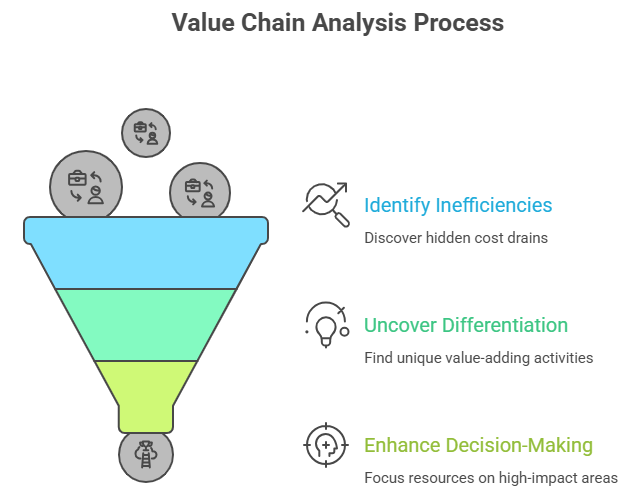
Determining Cost Advantages.
Value Chain Analysis shows you the latent inefficiencies sucking out your profits through careful analysis. To give an example, the legendary warehouse automation at Amazon did not take place by chance. Their inbound and outbound logistics analysis revealed certain bottlenecks and they invested in robotics, thus lowering the fulfillment costs by about 20 percent.
Likewise, your company may also find out that changing suppliers, re-engineering the processes or automating certain activities may save thousands of dollars per year.
Discovering Opportunities of Differentiation.
In addition to saving costs, Value Chain Analysis also shows the areas where you can be distinguished. Look at the example of Apple: they analyzed what they found to be the extreme value of customer service. Thus, they increased their investment in the Genius Bar support and cohesive product ecosystems and charged premium prices even though the costs of production increased.
Improving Strategic Decision-Making.
Resource allocation will be easy when you know what activities add the highest amount of value. You can concentrate on areas of high impact that are really important to customers rather than diversify investments.
Value Chain Analysis: A Step By Step Guide.
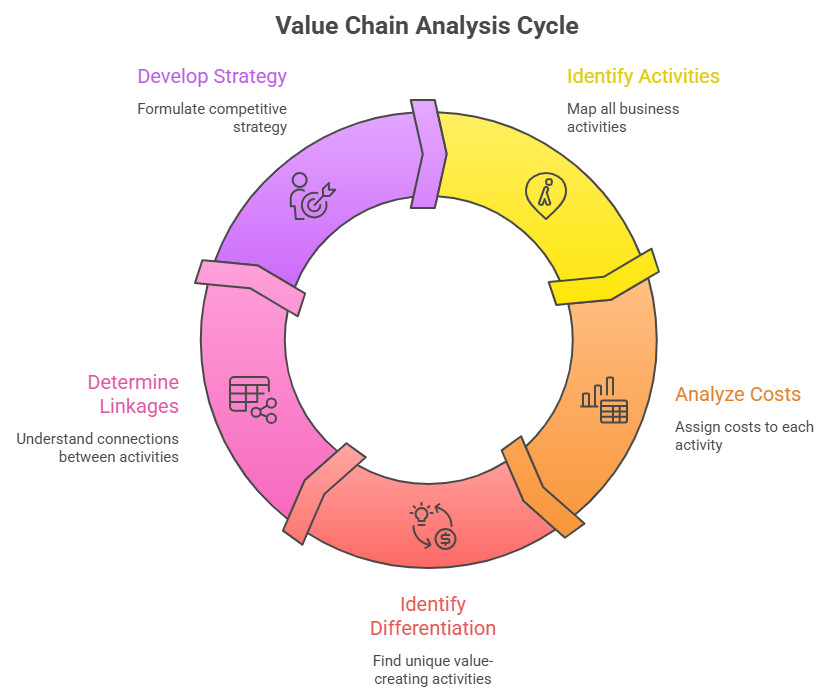
Step 1: Recognize Every Value-Creating Activity.
Begin by mapping all the activities in your business. Also, do not omit so-called insignificant steps, as sometimes even the most insignificant things cause or bring immense value or waste.
Write up an extensive list of:
- Raw material sourcing
- Production processes
- Quality control measures
- Distribution channels
- Customer support systems
- Marketing initiatives
Step 2: Analysis of Costs per activity.
Secondary, cost each of the identified activities. This involves in-depth information gathering, and the knowledge is priceless. The benchmarking studies in the industry indicate that most organizations incur 10-15 percent of the costs incurred in low-value activities.
Monitor direct (materials, labor) and indirect costs (overhead, utilities). Besides, think of opportunity costs, what might you accomplish with reallocated resources?
Step 3: Determiners of Drivers of Differentiation.
On any given activity, inquire: Does this make us different or superior to competitors? Potential differentiation drivers include activities that will improve quality, speed, convenience, or customer experience.
In order to illustrate this, Zappos found customer service to be a very important point of differentiation. They in turn invested in 24/7 support and free returns making logistics and service competitive weapons instead of cost centers.
Step 4: Decision on Linkages between Activities.
Activities do not work in a vacuum. Knowledge in relations provides opportunities of optimization. Customer service costs tend to reduce when the quality of production goes up. Equally, enhanced procurement may help to increase the efficiency of the operations.
Bain and Company research has indicated that companies which have optimally structured cross-functional linkages take 30% shorter time to markets than siloed operations.
Step 5: Competitive Strategy Being Developed.
Lastly, apply your wisdom to develop strategy. Choose between:
- Cost Leadership: Focus on streamlining its operations to be the lowest-cost producer.
- Differentiation: Improve particular operations to provide better value.
- Focus Strategy: Go into market niche with differentiated value chains.
Practical Implications: Value Chain Analysis Practically.
The Toyota Lean Production: Manufacturing Excellence.
Toyota brought revolution in manufacturing with intense Value Chain Analysis. They were able to do this by regarding each step of production as waste (muda) by the Toyota Production System. Therefore, they have lowered the production expenses by 25-35 percent and enhanced quality, which illustrates the power of analysis of operations in providing actual outcomes.
Innovation in Retailing: Distribution Mastery of Walmart.
The power held by Walmart is due to its better logistics. According to their Value Chain Analysis, certain efficient distribution centers and cross-docking methods would allow lowering inventory costs significantly. Thus, they have developed a logistics system that is 30 percent faster and 15 percent cheaper than other rivals.
Technology Leadership: Content Delivery in Netflix.
Netflix looked through the whole value chain and realized that the content delivery technology played a vital role. In addition, they spent a lot of money on streaming capabilities and recommendation systems and became not DVD rentals but streaming giants and gained more than 230 million subscribers all over the world.
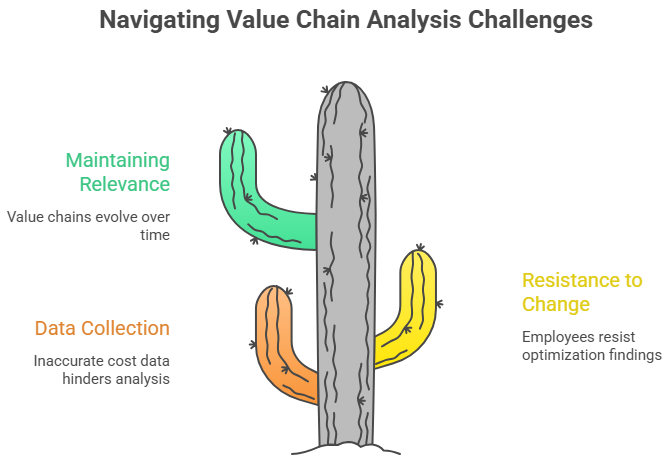
Potential Obstacles and the way to overcome them.
Challenges in the collection of data.
The problem with many businesses is that it is difficult to compile the correct cost information regarding each activity. In order to beat this, you have to start with easily accessible information and later narrow your analysis. Moreover, the data collection can be automated by accounting software and ERP systems.
Resistance to Change
The workers might not accept a conclusion that their departments are supposed to be optimized. Thus, get the team members engaged in the analysis early on and focus on improvement and not blame.
Maintaining Relevance
The value chains change with the change of markets. Periodic conduct analysis once every year or at the time of any major change in the market. In addition, observe the competitors value chain to establish new threats and opportunities.
Advanced Strategies: Progressing Value Chain Analysis.
Digital Integration of Transformation.
Digital tools have been included in modern Value Chain Analysis. Sensors of IoT monitor logistics, artificial intelligence is used to optimize the process, and blockchain can improve transparency. Those companies that accept the concept of digital value chain optimization record 20-40 efficiency improvements.
Sustainability Considerations
The modern consumers appreciate environmentalism. Examine your sustainability value chain- to reduce waste, carbon footprint, and source in an ethical manner. Research suggests that 73 percent of the consumers tend to choose sustainable brands.
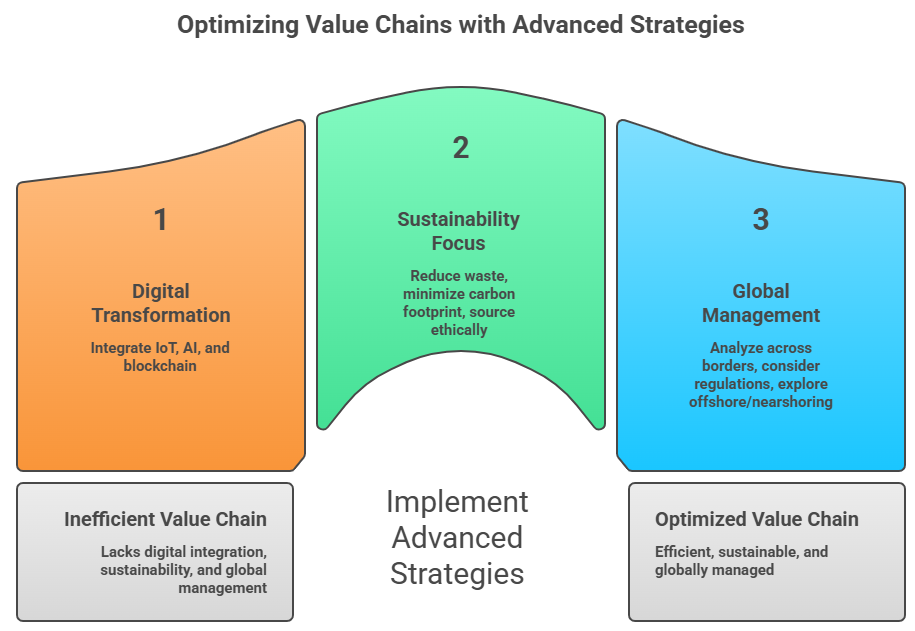
Global Value Chain Management.
In the case of international businesses, cross-border value chain analysis. Take into account tariffs, exchange rates and regional regulations. Also, seek offshore possibilities or near shoring to equalize the expenses and responsiveness.
Summary: Your Competitive Excellence Roadmap.
Value Chain Analysis is not a business buzzword, it has proven itself to be a methodology in helping you to know both where exactly your business generates value and where potential opportunities lie. The systematic study of activities, cost analysis and differentiation opportunities can help you have the knowledge of how to beat your competitors on a regular basis.
It is important to remember that it is a commitment to implementation. Break it down into little manageable parts and analyze one business unit or product line and then start to analyze the organization as a whole. Furthermore, ensure Value Chain Analysis is a continuous process as opposed to a one-time process.
Competitive environment is always changing and those businesses that recognize their value chains are able to better adjust to changes, work more efficiently, and create high customer value. So, start your Value Chain Analysis today, your competitive advantage in the future is in it.
Are you willing to make changes in the way you run your business? Get a free Value Chain Analysis template and begin to recognize your competitive advantages. Being strategic is a process that you can share your experiences with in the comments below and with that, we can create a community of business leaders who are strategic in their decisions.