
Introduction: Every Business Leader must have SWOT Analysis in the Strategic Tool Kit.
Imagine this: You are about to enter a crossroad with your business, and you need to choose to either introduce a new product, a new market, or change the whole approach. What is the best way to make the right choice? It is here that SWOT analysis is joining up as your greatest companion in strategy management.
Basically, Strengths, Weaknesses, Opportunities, Threats, refered as the “SWOT” table. It is a tool that has assisted countless companies to make smarter choices since it was formulated by Albert Humphrey in the 1960s as part of the Stanford Research Institute. As a startup founder, experienced executive, business person, or perhaps just trying to survive in the current competitive environment, learning how to use this tool may spell the difference between success and survival in the present environment.
This guide will look at how SWOT analysis can be used to translate abstract business problems into strategic management action plans. You will find actionable tips on how to do your own analysis, get inspired by the real-life examples, also get to the insights that will help you redefine your business course, it is time to explore why this proven framework is still a imperative in the contemporary strategic management.
What Is SWOT Analysis and Why Is It Important to Strategic Management?
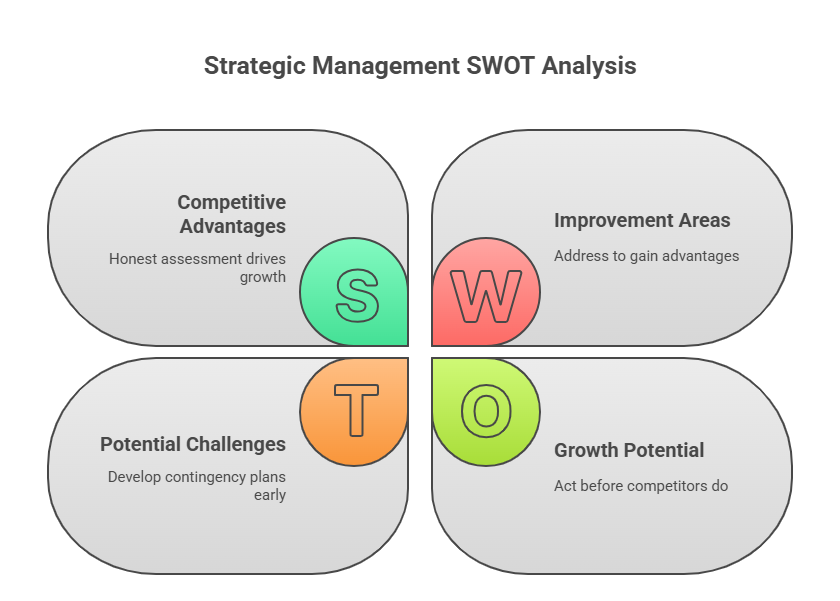
SWOT analysis is the system of planning that analyses four paramount aspects of your project or business. Consider that it is like taking a 360-degree X-ray of your organization and its health and potential.
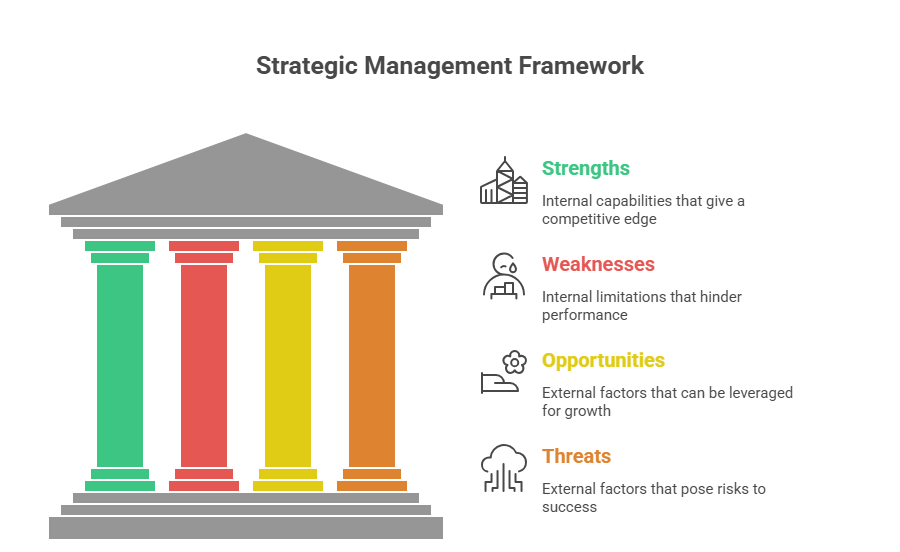
Accordingly, following is the representation of each component:
Strengths (Internal, Positive): This is what you do best, what your competitors are unable to do, etc. Your advantages may be skilled labor force, innovative technology, a good brand or effective operations.
Weaknesses (Internal, Negative): These are internal constraints that are keeping you down. Weaknesses may include lack of resources, obsolete technology, skills shortage or inappropriate location. Accordingly they are not to be recognized based on self-criticism, but rather on the basis of honest assessment.
Opportunities (External, Positive): These are positive external opportunities that you can take advantage of. Opportunities to be exploited can be the market trends, the evolving regulations, new technologies or even the gap in the competitor provisions.
Threats (External, Negative): These are external threats which are likely to damage your business. The threats can be economic slowdowns, entry of new players, shifts in consumer tastes or a technological upheaval.
A study by Harvard Business Review reveals that companies that undertake strategic analysis regularly have a higher chance of attaining their business goals by 33 percent. This is one of the reasons why SWOT is a staple of any successful strategic management practice in the world.
A SWOT Approach to the Four Pillars of Strategic Management.
Examining Your Strengths: Strengths Profiles.
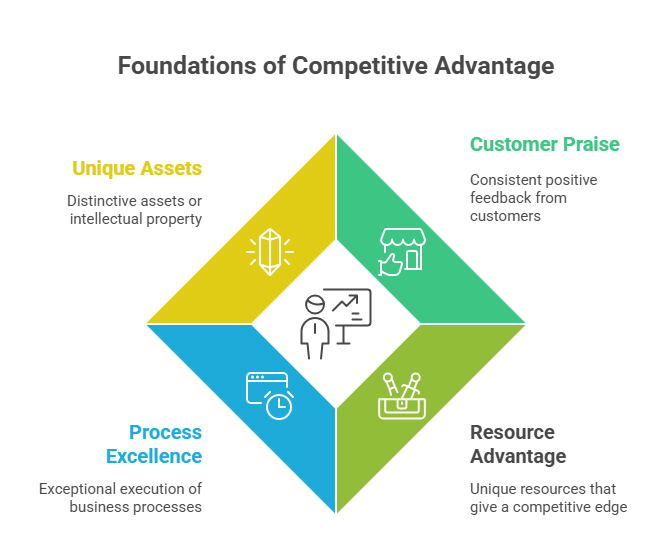
Afterward competitive position also has its foundation on your strengths. In order to define them clearly, answer the following:
- What are the things that the customers always appreciate in our business?
- What are the resources that make us have an advantage over our competitors?
- What are our processes that we perform exceptionally well?
- What are our special assets or intellectual property?
SWOT Analysis: The strengths of Apple as illustrated in a SWOT analysis include their integration into an ecosystem, a strong perception of their brand, their customer loyalty, and their innovative design abilities. These advantages directly form part of their strategy management decisions be it pricing strategies or product development schedules.
Be detailed when writing about strengths. As opposed to saying good customer service, measure it: 24/7 customer service where 95% satisfied and average response time of less than 2 minutes. This particularity enables you to make your strengths actable to your strategic management planning.
Dealing with Your Weaknesses: The Realistic Evaluation is the Growth Push.
It takes boldness and impartiality to admit their weakness. Although it is not about living in the past, but finding out where to improve and this can be turned into competitive advantages once this has been done.
Consider these questions:
- In which areas are our competitors more effective?
- What are the resources we are missing?
- What are the common processes that introduce bottlenecks?
- What are the complaints of the customers telling us about our weaknesses?
Real-World Insight: Netflix used to enumerate the absence of their original content as a weakness. Instead of letting it pass over their head, they spent billions on content development and turned this weakness into their major asset. This proves that truthful SWOT analysis will provide revolutionary strategic management choices.
Pro tip: Use interdepartmental involvement in the recognition of weaknesses. Employees who are on the front lines of service are usually very helpful in identifying problems that the leadership would not see, and this is an invaluable contribution to your strategic management system.
Finding Opportunities: Where to Grow.
Opportunities are at the point of meeting the market trends and your capabilities. These windows have to be identified and acted on before the competitors can do it in successful strategic management.
Look for opportunities in:
- Market gaps: Under-served customer groups or unmet needs.
- New technologies: Technologies that may enhance your business.
- Industry changes: Regulatory, consumer behaviour, or competitive changes.
- Partnering opportunities: Strategic partnerships that can widen your horizons.
McKinsey research shows that companies that scan and respond to opportunities more actively increase their revenues 2.5 times faster than companies that do not.
Practical Case Studies: As COVID-19 shut down restaurants, their diligent operators realized that there was a business case in ghost kitchens and delivery optimization. Others failed and those who turned on their heels successfully. The difference was in this agility of strategic management.
Raising Threats: Anticipating Hardships.
Threats may occur in a flash or develop over a period of time. In any case, they can be identified at an early stage using SWOT analysis and as such, you can devise contingency plans as part of your strategic management strategy.
The typical types of threats are:
- Threats of new entrants, intense competitor actions, or price wars.
- Economic risks: Recession, inflation, or supply chain disturbances.
- Threats in technology: Innovative threats that can render your products obsolete.
- Regulatory threats: New regulations or compliance requirements, which add costs.
Case Study Blockbuster did not appreciate the threat of streaming technology in their SWOT analysis which resulted in their death whereas Netflix took it as an opportunity. This conspicuous contrast exemplifies that the threat assessment directly influences the results of strategic management and its long-term sustainability.
The Stepwise guide: How to do your SWOT analysis.
At this point, having explained the elements, now we are going to have a step-by-step approach on how to perform a comprehensive SWOT analysis.
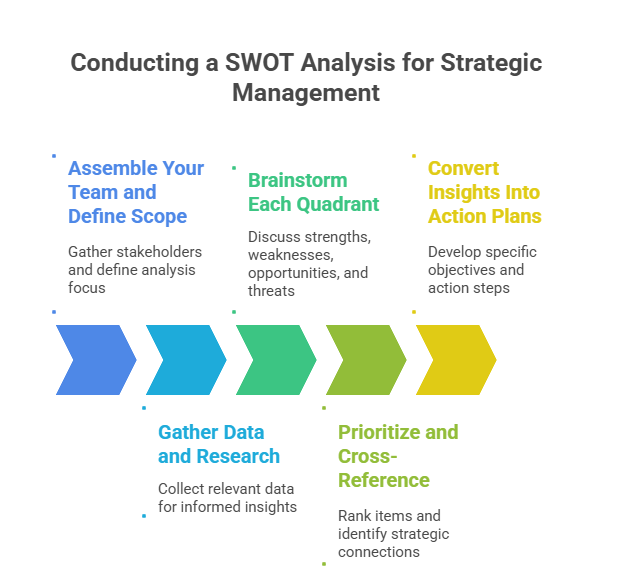
Step 1: Team building and scope definition.
Good SWOT analysis is not an individual exercise. Bring together stakeholders of various departments- marketing, operations, finance, and customer service. The different viewpoints ensure that you are not blindfolded in your strategy management process.
There is a need to be clear about what you are analyzing. Is it the evaluation of your whole organization, a particular product line, a market entry decision, or an operational change? Ensuring a narrow scope is important to have focused actionable insights.
Step 2: Data and Research Collection.
Gather the appropriate data before brainstorming:
Financial performance indicators.
Feedback and satisfaction rating by customers.
Competitor analysis report.
Trend forecasts of the industry with sources such as IBISWorld or industry-related publications.
internal services efficiency measures.
This study will use facts and not conjectures to base your SWOT analysis, which will reinforce your strategic management platform.
Step 3: Brainstorm every quadrant.
Allot specific time to every component of the SWOT. Use these prompts:
Strengths:
- What are the strengths that we possess over the competitors?
- What are the special resources we have?
- What is the thing we do more than anybody?
Weaknesses:
- In which areas do we lag behind the competition?
- What do we lack in resources?
- What is creating customer complaints?
Opportunities:
- What are the market trends that we can exploit?
- What are the weaknesses of the existing market?
- What do new possibilities brought about by technology look like?
Threats:
- What obstacles do we face?
- What are the competitors intending?
- What are the looming economic or regulatory changes?
Support open and judgment-free dialogue. Record all that- even what might appear as little details can give rise to great strategic management.
Step 4: Cross-Reference and Priority.
SWOT elements are not equal. Prioritize within each of the categories in terms of importance and urgency. Then, look for connections:
- Are you able to leverage opportunities using strengths? (SO Strategies)
- Is it possible to counter threat using strengths? (ST Strategies)
- Are you going to take care of weaknesses to avail of opportunities? (WO Strategies)
- What can you do to reduce weaknesses and eliminate threats? (WT Strategies)
This cross-referencing, which is also known as TOWS analysis, will make your SWOT more dynamic as a strategic management tool that will produce actual actionable strategies to take.
Step 5: Transform Insights into Action Plans.
Strategic decision-making is the end product of SWOT analysis. Develop: Develop each high-priority item.
- Specific objectives
- Action steps
- Responsible parties
- Timelines
- Success metrics
In the absence of this action conversion, your SWOT analysis is just theory. Strategic management demands the ability to convert knowledge into actionable plans that can make the organization move forward.
SWOT Analysis in Practice: Strategic Management Success Stories.
Case Study 1: Market Growth of Starbucks.
In the case of Starbucks, they were intending to go global and they analyzed their strengths and weaknesses and found out that:
Strengths: Well-established brand name, established business model, good products.
Threats: The expensive prices, inadequate understanding of local tastes.
Opportunities: Increased middle classes in emerging markets, expansion of the coffee culture.
Threats: Domestic competition, economic uncertainty.
Their strategic management is as follows? Form partnerships with local businesses, localise menus, and invest in high-end positioning. This SWOT-driven strategy made Starbucks enter into more than 80 countries successfully.
Case 2: Auto Industry Disruption by Tesla.
In the SWOT analysis, innovative technology and environmental attractiveness were seen as the primary strength of Tesla, the scale of manufacturing was taken as the weakness, increasing EV demand was considered an opportunity, and established automakers were observed as a threat.
Their strategic management choices were based on vertical integration in order to overcome their weaknesses, fast-track innovation in order to sustain technological advantages, and brand loyalty in order to repel threats. The result? Tesla was the most valuable company in the world in terms of automakers.
The Top 3 SWOT Analysis Pitfalls to Strategic Management.
These are some of the mistakes that even experienced leaders commit:
Being Too Vague: “Good reputation” is not useful, but “95 per cent customer retention in a market where the average is 70 per cent” is.
Mistaking between Internal and External Factors: Strengths and weaknesses are the internal. The external opportunities and threats are external. Combining these groups will cause poor strategic management conclusions.
SWOT Conducting Once and Forgetting It: Markets change all the time. Set up periodic SWOT analysis within a quarter to maintain your strategic management nimble.
Collusion with Uncomfortable Truths: When you enumerate on things that are good and opportunities and downplay on things that are bad and threats, you are just preparing to fail. It is imperative to be truthful.
Actionless Analysis: Failure to take action is time-wasting. Your SWOT has to be a decision maker or it has no role in your strategic management process.
Benefits SWOT.
SWOT analysis is a great tool, but its integration with other models forms even greater strategic management:
PESTLE Analysis analyses opportunities and threats in greater detail by considering the Political, Economic, Social, Technological, legal and environmental influences.
Porters Five Forces is used in analyzing the competitive dynamics that enable you to comprehend threats of competitors, new entrants, substitutes, suppliers and buyers better.
Balanced Scorecard transforms SWOT knowledge into quantifiable goals in financial, customer, internal process, and learning perspectives of the score card.
Scenario Planning involves the SWOT elements to consider several possibilities of the future to get your organization ready to face many possibilities in your strategy planning.
The Digital Age: How to put Technology to the Swift to Supercharge Your SWOT Analysis.
The use of technology in modern strategic management helps to improve the classical SWOT analysis:
Group brainstorming programs can be facilitated real-time using things like Miro or Mural with remote members.
Using AI-based solutions can review customer feedback, social media buzziness, and competitor engagement to discover your strengths, weaknesses, opportunities, and threats that could otherwise be overlooked.
Strategic management is more responsive to business intelligence dashboards of business intelligence tools such as Tableau or Power BI that visualize SWOT elements using real time data.
Project management tools such as Asana or Monday.com can be used to translate SWOT knowledge into actionable items that can be tracked and have accountability and timelines.
The Gartner research indicates that an organization that utilizes digital tools to engage in strategic planning finishes the analysis 40 times faster and executes the strategy 35 times better than an organization that utilizes conventional tools.
SWOT Analysis Best Practices of Sustainable Strategic Management.
You need to maximize the usefulness of SWOT in your strategic management answer:
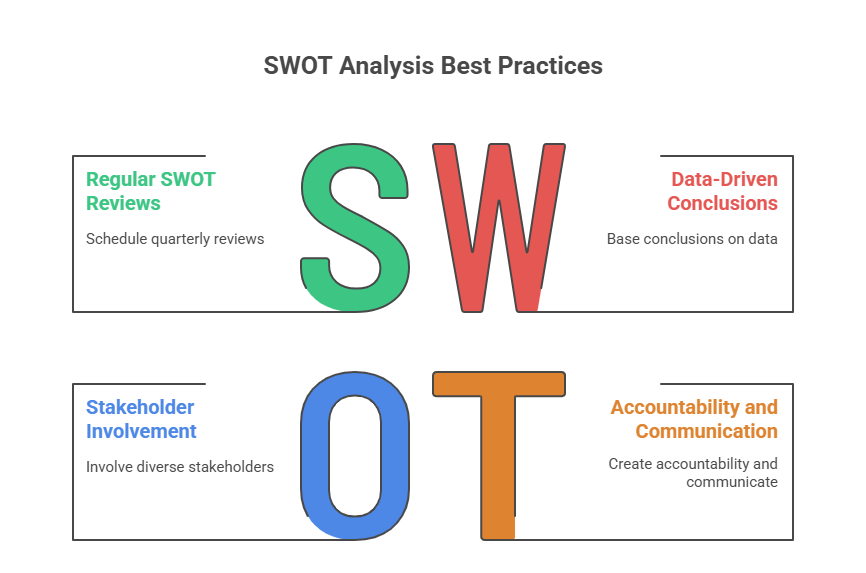
Regular not occasional. Periodic Schedule SWOT SWOT reviews can be conducted quarterly or when there is a major change in your market or company.
Engage different stakeholders. The various attitudes avoid groupthink and provide some unsuspected knowledge to enhance the strategic management results.
Make conclusions based on facts as opposed to assumptions. Ground your analysis in reality by using customer surveys, financial metrics, market research and competitive intelligence.
Create accountability. Designate an owner to every strategic move that arises out of your SWOT analysis so that strategic management decisions are followed up.
Share results extensively. Publish SWOT outcomes throughout your organization to make all comprehend strategic priorities and can bring their effort into coordination with the overall strategic management vision.
Measure and adjust. Monitor the results of decisions made with the help of SWOT and improve your approach depending on the results, making the process of strategic management a continuous circle of improvement.
Conclusion: SWOT Analysis Your Strategic Management Competitive Advantage.
SWOT analysis is among the most accessible but an effective strategic management tool. Through the systematic assessment of your strengths, weaknesses, opportunities and threats you will have a clarity which will be able to convert the complex issues in the business into a strategic choice.
It is important to remember that the real worth of SWOT does not consist in the ability to make a four quadrant graphic. It is found in the truthful discussions it will give rise to, the blind detention it will manifest, and the tactical moves it will provoke. Firms engaging in consistent SWOT research not only respond to change but they also anticipate it, adapt to it and to a great extent, lead it to their benefit; they do this by engaging in proactive strategic management.
You are in charge of a startup or running a department or a multinational corporation, SWOT analysis gives you the strategic compass you can use to sail in uncharted territory without fear. Begin your analysis the first day, and turn it into a habit and you will see that a clear vision is turned into great performance and long-term competitive advantage.
Your Strategic Management Journey Begins Here.
You are ready to change your strategic planning? You can start this week by doing a SWOT analysis of your business or project. Recruit your staff, conduct the above steps and make the promise of acting on what you will learn.
Have you ever applied the SWOT analysis to your organization? What results did you see? Share your experiences in the comments below.
Always to keep in mind: the best strategy is the one that you put into practice. Find a better way to make smarter and more confident business choices today by making SWOT your starting point.