
Introduction: The Real Impact of Financial Statements is Bigger Than You Think.
Imagine this: you are going to spend your hard earned money on investing on a promising company, yet how will you be assured that it is a profitable company? Or maybe you are just running a business and you need to know whether you are actually making money or you are just busy doing nothing. Financial statements come in as your friend at this point.
The official records that demonstrate the financial performance and position of a company are financial statements. Consider them a report card of a business- they give you all the details of a business, including revenues, costs, assets, and debts. Besides, they are no longer restricted to accountants. Regardless of whether you are an investor, a business owner, a lender, or just a person with interest in financial literacy, knowing these documents can change the way you take decisions.
This big book will cover the three main kinds of financial statements and break them down, and then demonstrate how to extract information with these statements that can be of helpful value. At the end, you will be reading these papers as a professional.
What are Financial Statements?
Financial statements are mandatory documents which convey the financial operations and status of a business or an organization. They present an image of financial wellbeing at any given time and during given durations.
The financial statements in the United States are required to be prepared using Generally Accepted Accounting Principles (GAAP) as stipulated by the Financial Accounting Standards Board (FASB) so as to allow uniformity and transparency within the organizations.
The Three Main Financial Statements.
Income Statement: Your Blueprint of Profit.
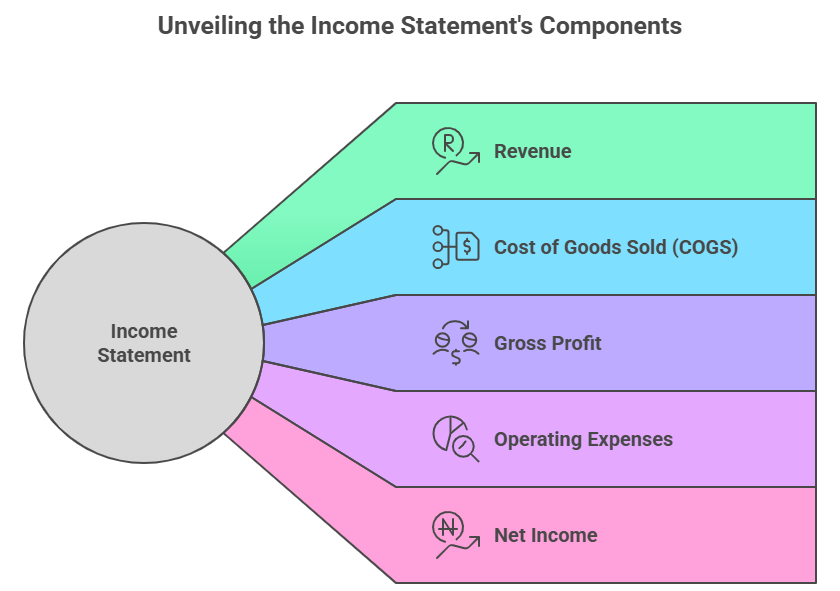
The income statement, also referred to as the profit and loss (P&L) statement, indicates the amount of money that a given company received and incurred within a given period of time. It provides an answer to one very important question: Is the business profitable?
Key Components:
- Revenue: This is the total sales income or services income.
- Cost of Goods Sold (COGS): Direct product production costs.
- Gross Profit: Revenue less COGS
- Operating Costs: Costs such as salaries and rent on a daily basis.
- Net Income: The final result is after adding all expenses, taxes.
Indicatively, when a retail business made 500,000 in sales but incurred 450,000 in inventory purchases, salaries and rent, their net income would be 50,000. This figure informs the stakeholders whether the business model is effective.
Actionable Hint: Comparison of the gross profit margin (gross profit/revenue) with industry standards. IBISWorld records that the healthy margins differ by industry, with software firms usually having 70-80, and grocery stores usually having 20-25.
The Balance Sheet: Your Financial Overview.
The balance sheet, unlike the income statement which covers a given period, shows a financial position of a company at a given time. It is based on the following basic equation:
Assets=Liabilities +Shareholders Equity.
Distribution of the Components:
- Assets: All the items that the company possesses (cash, inventory, equipment, real estate)
- Liabilities: Debts held by the company (loans, account payable, mortgages)
- Shareholders Equity: Interest left after deductions of liabilities against assets.
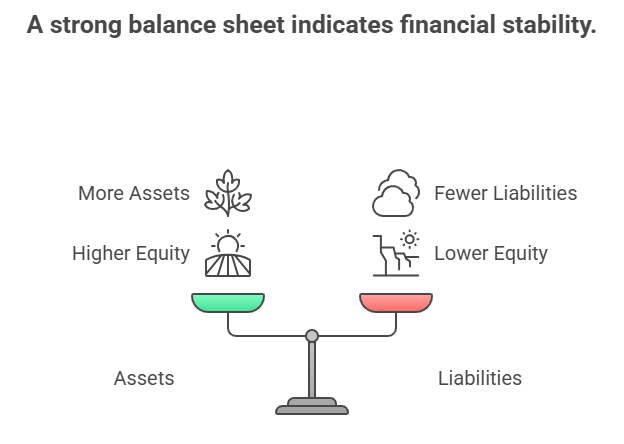
Consider it the following way: suppose you purchased a house of 300000 dollars with a mortgage value of 200000 dollars, then you have assets 300000, liabilities 200000, and equity 100000. On the same note, companies use this formula to monitor their net worth.
Insight : A good balance sheet has greater assets than liabilities, which implies that it is financially stable. Also consider the current ratio (current assets/current liabilities), in order to determine short term liquidity. Any ratio that is above 1.5 is normally an indication of good health.
Cash Flow Statement: Your Liquidity Reality Check.
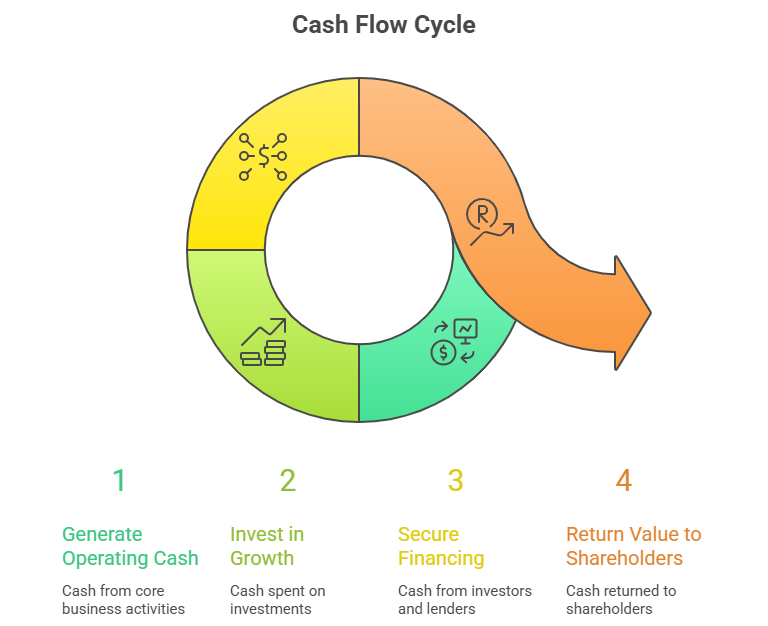
This is a shocking fact: even profitable companies may become bankrupt. How? They run out of cash. The cash flow statement is used to monitor the real cash flow in and out of the business which is classified in three categories:
Operating Activities:
Funds of core business processes. This encompasses the amount of customer payments that are received and supplier payments made. Positive operating cash flow shows that the business is able to generate enough cash out of its main operations.
Investing Activities:
The amount of money given or given up on investments such as purchasing of equipment, purchasing of property or selling of assets. Negative cash flow is not always bad in this case, it may be an investment in the growth of the company.
Financing Activities:
Shareholders or creditors, such as the payment of dividends, stock issues and loan repayments, in cash. This section discloses the manner in which the company finances its operations, and how the company gives back to the shareholders.
Case Study: Amazon has notoriously managed with low profits over many years with positive cash flow as an operating company. That has enabled them to invest heavily in infrastructure leading to taking over e-commerce.
Effective Financial Statement Analysis.
Ratio Analysis: Numbers That Tell Stories.
It does not indicate much when the numbers are raw. Thus, financial ratios can aid in the comparison of the companies of varying sizes and industries.
| Ratio Type | Formula | What It Reveals |
| Profitability | Net Income ÷ Revenue | How much profit per dollar of sales |
| Liquidity | Current Assets ÷ Current Liabilities | Ability to pay short-term obligations |
| Leverage | Total Debt ÷ Total Equity | Reliance on borrowed money |
| Efficiency | Revenue ÷ Total Assets | How well assets generate sales |
An example is that a debt-equity ratio that is greater than two implies that there is a lot of leverage and risks are likely to grow in times of economic recession. In the meantime, the ROE of more than 15% is usually a sign of good performance of the management.
Trend Analysis: The Strength of Time.
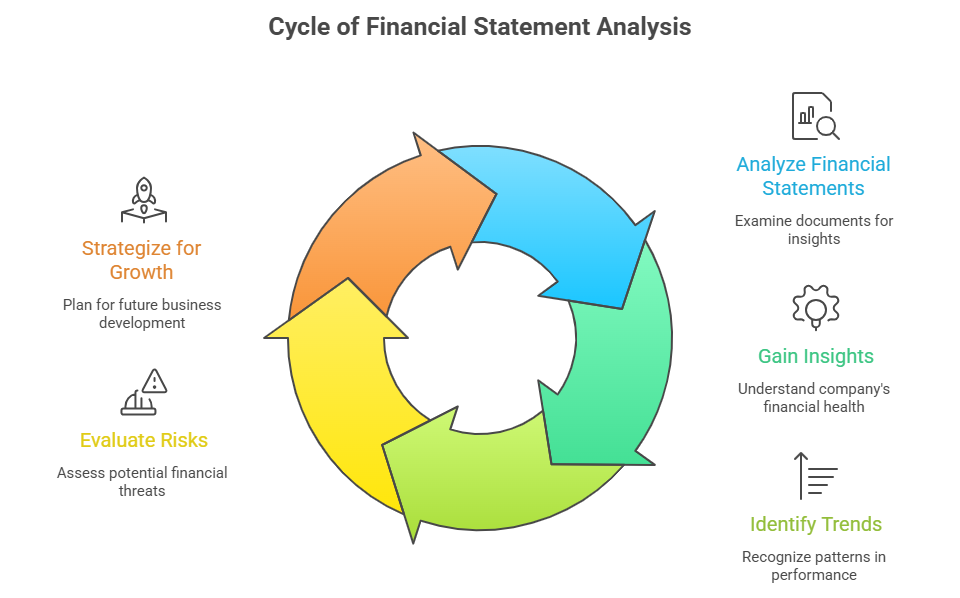
The statements of one year will be one portion of the story. But when you compare three to five years, the most important trends can be seen. Does it have a steady increase in revenue? Is there an improvement or a decrease in the profit margins? Is the rate of growth of debt higher than the rate of growth of assets?
Implementation Plan: Develop a basic spreadsheet that tracks the important metrics after every quarter. Find trends- sudden changes are usually indicators of critical changes in business strategy or market conditions.
Common Red Flags to Watch
Deteriorating gross margins: May reflect a decline in prices or increased costs.
Increased accounts receivable: The customers may be having difficulties in paying.
Continuous negative cash flow: With reported profits.
Rising debt ratio and a stagnant growth in revenues: Possibly unsustainable growth policy.
The research conducted by CFA institute indicated that trends across a set of statements are 40 percent more predictive than trends in a single period.
Practical Applications: What is the use of Financial Statements and Who Uses Them.
For Investors
The smart investors analyze financial statements to evaluate value and risk before purchase of stocks or bonds. Warren Buffett is notorious in reading annual reports, allowing him to spend hours on that matter and paying attention to sustained profitability and balance sheets.
Pro Tip: P/E ratio (stock price/ earnings/ share) and financial statements. Her low P/E with superior fundamentals may be a sign of an under-adopted opportunity.
For Business Owners
Your own financial statements would change the way you make decisions. Should you expand? Can you afford new equipment? Do you require extra financing?
In addition, banks must have in-depth financial statements to loan applications. A business owner who is well prepared with his/her numbers stands a high chance of approval.
For Creditors and Lenders
In order to establish creditworthiness, financial institutions examine these documents. They especially put an emphasis on the cash flow and debt service coverage ratios to assure that borrowers would be able to pay up the obligations.
Digital Tools That Ease the Process of Financial Statement Analysis.
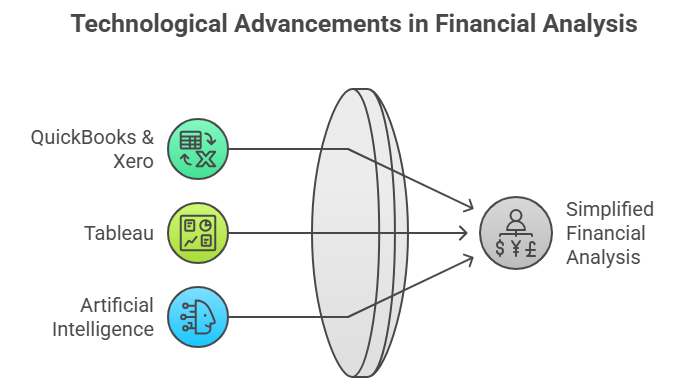
Technology has brought a transformation in the way we deal with financial information. Application software such as QuickBooks and Xero are able to automatically create statements based on transactional information. In the meantime, applications like Tableau generate visual dashboards, which render trends instantly obvious.
Also, the artificial intelligence today is used to indicate abnormalities and forecast the future performance based on the previous trends. These innovations allow the complex analysis to be available to the non-accountants.
Summary: Making Your Money Matter.
Financial statements are not just accounting requirements but they are great tools of learning the reality of business. Profitability can be determined by the income statement, financial position can be determined by the balance sheet whereas liquidity can be determined by the cash flow statement. Both of them can be used to give a full-scale picture of organizational health.
Through learning these documents you can make sound investment choices, run business in a prudent way and make judgments out of opportunities. It is important to remember that all successful investors and entrepreneurs have one thing in common; they can read and interpret financial statements.
Start practicing today. Get annual reports of publicly traded companies (free on the SEC web site), and apply the concepts we have discussed. Over time, you will have a sense of financial health that is intuitive and makes you unique in the business and investments.
Ready to dive deeper? Post your largest financial statement related query in the comment section or visit our similar guides on budgeting, investment strategy and business planning. What you need to begin with on your road of financial literacy is to learn the numbers that makes businesses successful.