
Why Financial Statements Analysis Matter More Than Ever.
Suppose we were driving a car without a dashboard. There is no speedometer, no fuel gauge, no warning lights it is all pure guesswork. That is what it is like to run or be invested in a business without having knowledge of financial statement analysis.
The financial statement analysis is your guide to success whether you are an aspiring investor looking at the first purchase of a stock, a small business person wanting to monitor the growth, or a just a person willing to make sound financial choices. In the modern day data driven economy, the capacity to read such documents distinguishes between flourishing and failing companies, intelligent investors and idiots, and those who can plan and lead their organisation compared to those who just act without proper planning. This is the importance of financial statement analysis.
The recent study conducted by the SEC shows that almost 60 percent of small business failures are caused by incorrect financial management and lack of knowledge about a financial health indicator becasue of not doing finacial statement analysis. In the meantime, investors who perform excellent financial analysis always beat those who do not by huge margins.
Here is our all-purpose guide on financial statement analysis, covering all the information that you should know about the financial statements, including the basics of the three fundamental documents, and the most important ratios that bring the actual financial status of the company to light. By the time you are through, you will be equipped and confident to read between the numbers and make decisions supported by sound data and not the gut feeling.
Three Pillars of Financial Statements.
It is appropriate to lay a good background by getting to know what these financial statements are and the reasons why companies are preparing these financial statements.
What are Financial Statements?
Financial statements refer to documents that are official and reflect the financial operations and status of a company. Just imagine them to be the report card of a company and they will tell you what the business owns, what it owes and how much it is making, its cash flow. These are not documents that are merely paperwork but strategic tools, which are required by various regulators such as Financial Accounting Standards Board (FASB) that promote transparency and accountability.
The Balance Sheet: Financial Overview.
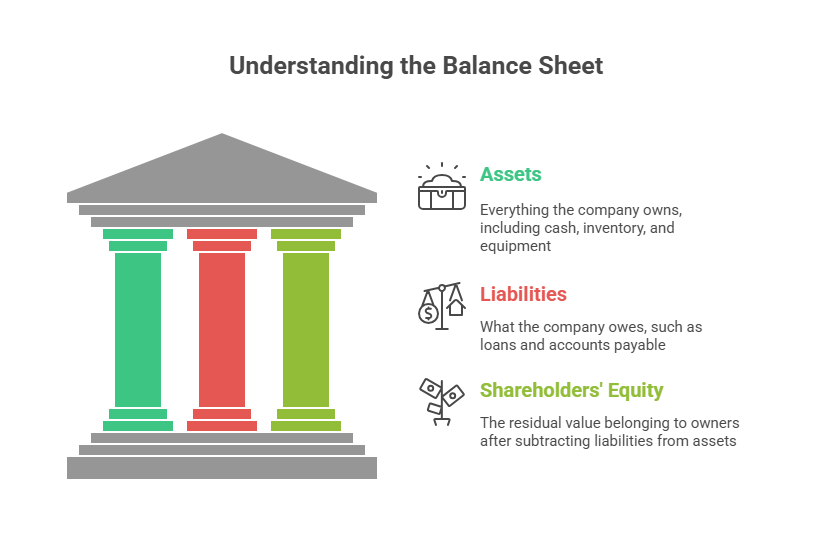
The balance sheet is the record that gives the picture of what a given company possesses and is owed at a particular time. It obeys a fundamental equation which never fails:
Assets = liabilities + Shareholders equity.
Key Components:
Assets: This is the sum of all things owned by the company and they include cash, inventory, equipment, real estate, patents and receivables.
Liabilities: The company owes, loans, accounts payable, bonds, and/or other debts.
Shareholders Equity: The amount that is left to the owners after deductions about liabilities against the assets.
As an illustration, when Apple has a balance sheet that is recorded to have an asset amounting to 350 billion as well as a liability amount of 290 billion, the shareholders will have a net worth amount of 60 billion in terms of equity- their net worth.
Income Statement- The Profitability Tracker.
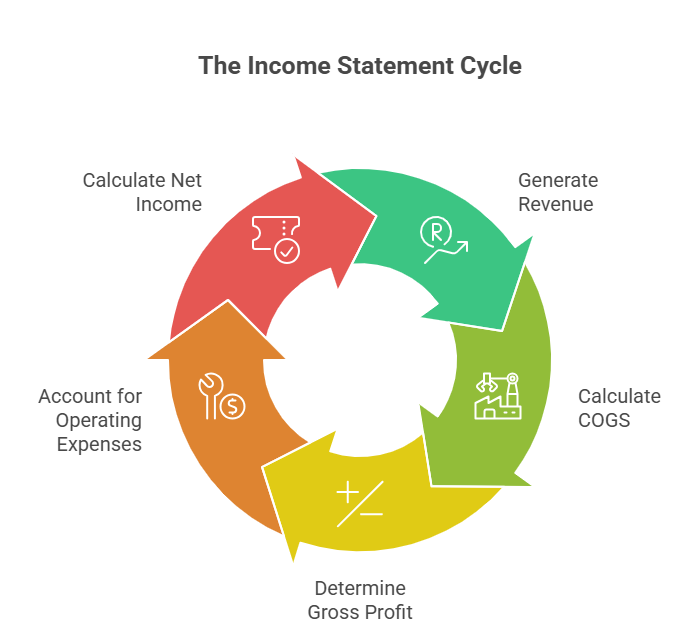
Whereas the balance sheet represents a picture, the income statement represents a film- it demonstrates financial performance as it goes (in most cases quarterly or annually). This report discusses the question that is of concern, namely: Is the company making money?
Essential Elements:
Revenue: Sum of revenue earned by selling goods or services.
Cost of Goods Sold (COGS): Direct expense of making whatever you sell.
Gross Profit: Revenue– COGS.
Operation Costs: Business running costs (salaries, rent, marketing)
Net Income: This is the bottom line, the amount remaining after all the expenses.
As per the findings of the financial analysis given by Deloitte, firms that have a steady growth of revenue and a higher profit margin, usually beat the competition within a span of five years by 3-4x.
The Statement of Cash Flow: Tracing the Money.
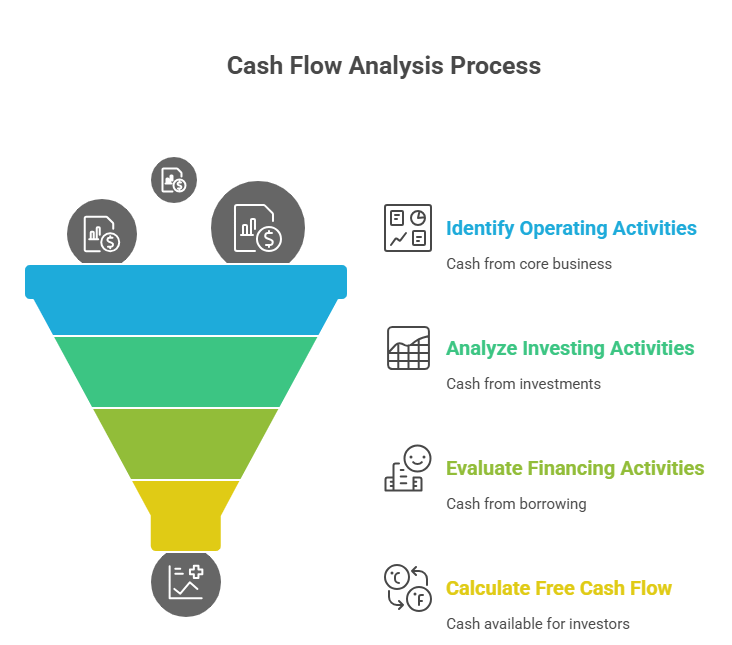
Here is one of the facts that a beginner overlooks and the profit is not cash. A company may run out of cash and still be profitable on paper and vice versa. It is the reason why the cash flow statement is arguably the most significant document in the evaluation of actual financial health.
Three Critical Sections:
Operating Activities: Cash of core business.
Investing Activities: Amount of money spent or received on investment (equipment, acquisition, securities, etc.)
Financing Activities: Cash either through borrowing or repayment of debt or issuing stock.
Warren Buffett is known to rank free cash flow (operations cash flow less capital expenditures) in the assessment of investments as cash available to be distributed to all investors.
Critical Ratios for Decision Making.
Having an idea of the fundamentals of financial statements, it is time to examine the ratios and metrics that can turn raw numbers into practical information. These ratios can assist you to compare performance of bigger companies with smaller ones, monitor performances over time, and identify red flags before these turn into catastrophes.
Liquidity Ratios: Is the Company paying its Bills?
Current Ratio = Current Assets/ Current Liabilities.
The ratio is used to evaluate the short-term financial health. The ratio of over 1.0 indicates that the company has more short-term assets than liabilities. Context is also important, though, a current ratio of 3.0 may reflect idle cash, whereas 0.8 may be indicative of difficulty in covering obligations.
Quick Ratio (Acid Test) = (Current Assets – Inventory)/ Current Liabilities.
This more rigorous test ignores inventory because this is not necessarily easily converted to cash. Technology firms are generally having higher quick ratios than the retailers since they have less inventory.
Profitability Ratios: Does the Business make Money?
Gross Profit Margin =(Revenue-COGS)/Revenue x 100.
This demonstrates the level at which a company is efficient in production of its goods. Margins of software firms are usually over 80-percent, whereas the grocery store has got another 2-3 percent.
Return on Equity (ROE) = Net Income/ Shareholders Equity x 100.
ROE shows the efficiency of the management in utilizing the investments made by the shareholders to make profits. As per the financial ratio analysis of Investopedia, an ROE of above 15 is generally excellent, however, different industries may have a higher or lower ROE.
Leverage Ratios: Just How Much Debt Is Too Much?
Debt-to-Equity Ratio = Total debts/ Equity of shareholders.
This is a ratio of financial leverage. A ratio of 2.0 indicates that the company has twice the debt amount as compared to the equity amount. Although certain sectors (utilities, real estate) are more likely to have high debt levels, over leverage increases profits and losses.
Interest Coverage Ratio= Operating Income/Interest Expenses.
Is the company able to comfortably make interest payments on its debt? The ratio of less than 2.0 is something to be worried about and more than 5.0 is an indication of financial flexibility.
Efficiency Ratios: Is the Management Operating a Tight Ship?
Asset Turnover = Revenue /Total Assets.
This is an indicator to determine the efficiency with which a firm utilizes its resources to drive sales. The retail chains are also known to have higher turnover ratios compared to capital intensive manufacturers.
COGS/Average Inventory=Inventory Turnover.
What is the rate of sale of inventory? Fast-fashion stores such as Zara have turnover 12+ times the year, whereas a luxury jeweler can have 2-3 times. It is not that either one is superior, but this depends on the business model.
Financial Statement Analysis Process in Steps.
One thing is individual components, and another is detailed analysis. Here is a step wise method that is adopted by professionals in the analysis of financial statements.
Step 1: Horizontal Financial Statement Analysis (Trend Analysis).
Get the same line items to compare between various periods to determine trends. Is change in revenue upward? Is the cost incrementing at a higher rate than the sales? The method exposes momentum and trends that are not indicated by single-period snapshots.
An example is that when the revenue of a company began to increase by 15 per cent last year and operating expenses also increased by 25 per cent, the company needs to dig deeper to find out the cause of the increase, could be due to the reason like expansion costs, inefficiencies or market pressure?
Step 2: Vertical Financial Statement Analysis (Common-Size Analysis).
Prepare every line item as a percentage of some base figure (total assets on balance sheets, revenue on income statements). This method enables you to make comparisons between companies of enormously different sizes.
Practical Application: It is possible that two rival restaurants may have varying absolute revenue but comparing the COGS of revenue expressed as a percentage of revenue will tell which has a more efficient kitchen.
Step 3: Ratio Analysis in Financial Statement Analysis.
Compare and contrast the most important ratios mentioned above. Do not simply compute numbers, give them meaning. Compare against:
- Historical ratios of the company (is it improving its performance)
- Industry standards (compared to peers?)
- Ratios of competitors (who is performing better?
Step 4: Competitor and Industry Comparison in Financial Statement Analysis.
Financial measurements do not count much alone. One of the industry analysis reports released by IBISWorld states that it is pointless to compare the metrics of a tech startup with the metrics of established manufacturers. Never stop benchmarking to the relevant peers who are in similar markets.
Step 5: Qualitative Evaluation in Financial Statement Analysis.
Numbers have a share of the story but not the whole story. Consider:
- Quality and track record of management.
- Business strategies and positioning.
- Economic situation and regulation.
- Brand and customer loyalty.
The CFA Institute states that the most appropriate analysts should integrate both the quantitative and the qualitative judgment.
Red Flags and Warning Signs Given on Financial Statement Analysis.
Financial statements even on casual analysis can give warning signals that may be further pursued by further analysis or even avoided altogether.
Revenue Recognition Issues.
Be cautious when revenues are increasing even faster and receivables are also increasing even faster. This could be a sign of aggressive recognition of the revenue or customers who are not able to make payments. Divide the total debt owed by the number of days to determine the efficiency of collections.
Deteriorating Margins.
In the event that the gross margins narrow and those of competitors remain at par, the company could be losing the pricing power- a severe competitive disadvantage.
Mounting Debt.
An increase in debt to equity ratios and a flat revenue growth indicates that a business is borrowing to live and not prosper. Particular attention to the debt maturing in the nearest future.
Cash Flow Disconnect.
The need to investigate immediately when net income is healthy but the operating cash flow (or operating cash flow pattern) is negative or negative. This deviation is usual before financial crisis.
Changes in Accounting.
Firms that keep on shifting accounting practices or rephrasing past performance should be subjected to additional questioning. Although justified in some cases, such acts may cover the real issues.
Applications and examples in the real-world Financial Statement Analysis.
Now, we will look at the application of financial statements analysis to real life scenarios.
Case Study: Comparison of Retail Company.
Take two retail chains, which earned the same revenue; namely, 500 million:
| Metric | Company A | Company B |
| Gross Margin | 35% | 28% |
| Operating Margin | 12% | 8% |
| Current Ratio | 1.8 | 0.9 |
| Debt-to-Equity | 0.5 | 2.1 |
| ROE | 18% | 24% |
On its face, the increased ROE of Company B is attractive. But a further examination shows worrying leverage (debt-to-equity 2.1), slim liquidity (current ratio less than 1.0), and poor margins. Company B uses financial lever to reach its ROE, as opposed to operational excellence, which is a more dangerous offer.
- Investor Scenario: Investment in a Stock Buy.
- Five years of financial statements should be analyzed before investing $10,000 in a stock. Look for:
- Uninterrupted growth in revenue (10 percent or higher per year in growth categories)
- Stable or expanding margins
- Good and increasing free cash flow.
- Manageable debt levels
- High returns on equity more than cost of capital.
Research conducted by Morningstar revealed that those who perform a proper fundamental analysis incur half or fifty percent less losses due to company specific problems.
- Small Business Owner Lensview.
- When you are operating a business, you should use monthly financial statement review so that you can:
- Track progress toward goals
- Detect cost overruns before they get out of control.
- Major purchases should be made when it is possible to do so on the basis of cash flow.
- Prepare for tax obligations
- Show lenders financial health.
Plan a monthly financial health check, where you will review the key metrics, compare them with budget and make changes to adjust strategies.
Analysis Resources and Tools.
Effective financial statement analysis is done without having to spend money on purchasing expensive software. These are some free to professional resources:
Free Resources:
- SEDC database of filings of public companies.
- Basic financial data Google Finance and Yahoo Finance.
- Ratio calculation in Excel or Google sheets.
Professional Tools:
- Institutional investors: Bloomberg Terminal.
- FactSet and S&P Capital IQ (overall financial databases).
- QuickBooks or Xero (in the case of financial management of small business)
Educational Resources:
- The courses of Financial Analysis offered by Coursera.
- Accounting and finance at Khan Academy.
- Study materials on CFA institute of advanced learners.
Conclusion: Boosting your Financial Mastery.
Wall Street professionals or fancy degree accountants do not have to analyze the financial statements. It is an acquirable ability that can enable anyone to make smarter choices about personal finances, whether investing their spare cash, operating a company, or just being interested in knowing more about the companies they work or shop with.
Keep in mind the following major lessons:
Begin with the fundamentals: learn about the three basic financial statements and what they tell us about the financial status, profitability and cash flow of a given company. Understand key ratios that bring out liquidity, profitability, efficiency and leverage. Always use metrics in comparison to past performance, the industry standard and competitors instead of seeing in isolation.
Above all, use a combination of the quantitative analysis and the qualitative judgment. Numbers will tell you what has happened however critical thinking and industry knowledge will reveal why and what it means to the future.
The best part? No financial statement you work on leaves you poorer than the one you have analyzed. Begin small- Choose a company you are interested in and go online and download their last annual report and go through the analysis step by step. In a few weeks, a trend will be formed and what appeared to be unreadable spreadsheets will become the bright signals that will direct you in making decisions.
Are you willing to apply your knowledge in practice? With the techniques discussed here, download this week a 10-K filing of a company on the SEC EDGAR database and practice an analysis of their financial statement. Post your results in the comment section or contact me in case of doubts, the journey to financial literacy is never lonely.
Which company do you analyse first? Please tell us your decision and the knowledge you find out!