
Introduction: The importance of Descriptive Statistics to every Business Professional
The next time you enter a boardroom presentation, you have crystal-clear information on the performance of your company. You are not afraid to give typical revenue data, customer satisfaction ratings, and market trends all supported with good numbers. This can be said to be the strength of business statistics, especially descriptive statistics.
Descriptive statistics is your basic set of tools to make sense of raw numbers, whether you are a startup founder trying to make sense of first sales data, or the manager of a corporation trying to understand the performance of the team. Furthermore, in the modern data-driven business environment, employees with the ability to summarize and relay data insights effectively have a huge competitive edge. In this guide, we will discuss how descriptive statistics can convert complicated data into useful business insights, including all the key measures, examples of their practical use, and the real-life examples that you can apply now.
What are Descriptive Statistics?
Descriptive statistics is the science of statistics that aims at summarizing and systematizing data in a meaningful manner. Descriptive statistics is merely a description of what the data represent unlike inferential statistics, which makes predictions about populations.
When applied in business statistics, they serve to assist organizations with the aid of summarizing the enormous quantities of data into a manageable form. An example is that, rather than taking 10,000 separate transactions with customers, descriptive statistics will enable you to visually understand some of the important trends (such as average purchase value or the most popular product) in just a few minutes.
The Descriptive statistics and Business Decision-Making
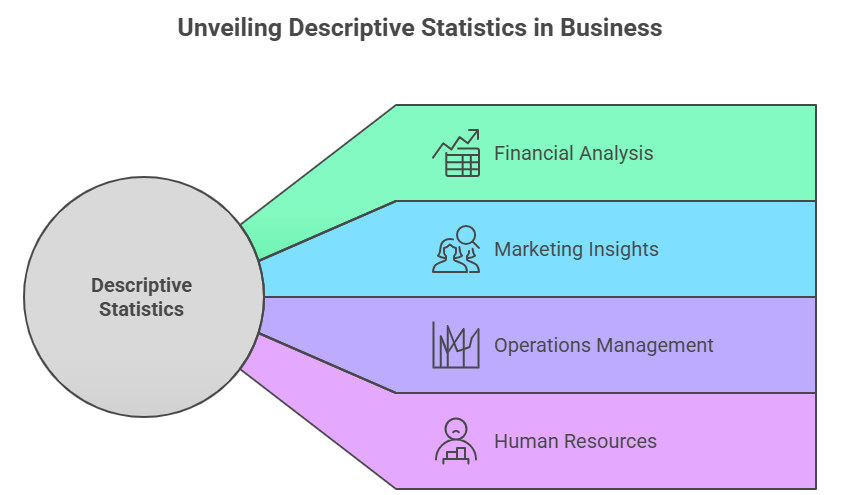
Firms employ descriptive statistics in their day to day activities:
Financial analysis: Monitoring the revenue patterns, profits and expenses.
Marketing insights: Customer demographics and performance of campaigns.
Operation management: Tracking quality control and production efficiency indicators.
Human resources: Evaluation of employee satisfaction, turnover levels and performance indices.
The research on data literacy states that 87 percent of the top business leaders are putting the enhancement of analytics at the forefront, which underscores the increasing significance of statistical literacy in the contemporary organizations.
Basic Descriptive Statistic types
The descriptive statistics has three main facets which collaborate to give you the full picture of your data.
Measures of Central tendency in Descriptive statistics
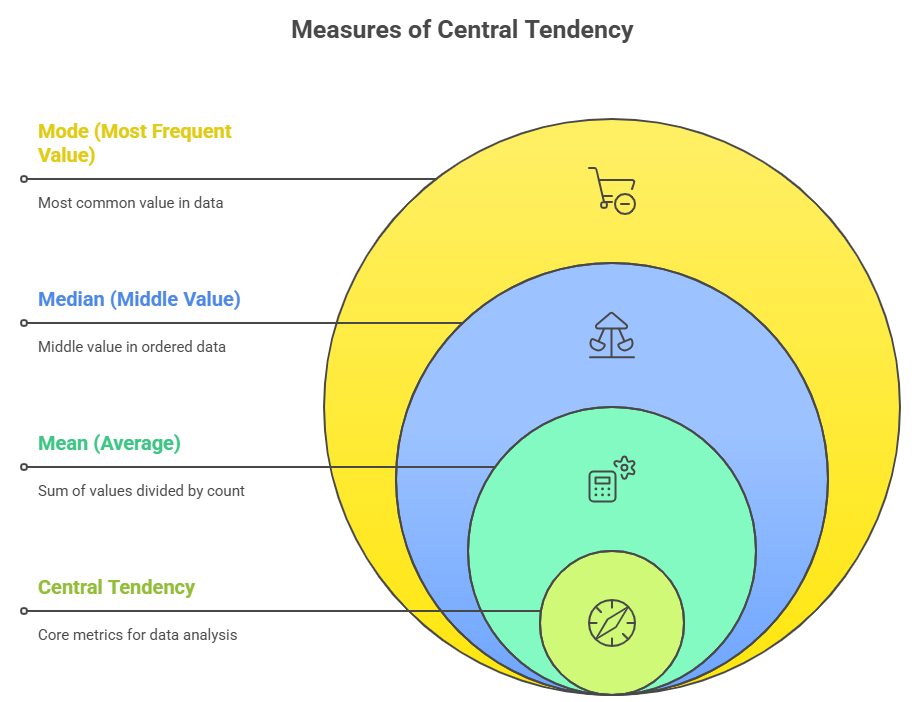
Such statistics determine the central or average value in a set of data. They therefore tend to be the first measures that business people take after analyzing data.
Mean (Average)
Arithmetic mean is the average of all values, which is given as a result of dividing them by the number. As an illustration, suppose that your sales team made sales of deal size of 50,000, 75, 000, 60,000, and 90,000 last quarter, the average deal value will be 68,750. This statistic is most effective with normally distributed data without any extreme data points.
Median (Middle Value)
The median can be defined as the average value in the case of an ordered data. In the same sales example, the arrangement of values will get us: 50,000 -60,000 -75,000 -90,000- the median value will be between 60,000 and 75,000, which is 67,500. It is important to note that the median is resistant to the effects of outliers in comparison with the mean, and it is, therefore, useful in analyzing salaries or property values.
Mode (Most Frequent Value)
Mode means the most common value. The mode is used in retail business statistics to determine the products selling well or most frequent quantities ordered. A clothing store may find that Medium size is most prevalent in sales records, so it makes inventory choices.
Dispersion of Data (Measures of Variability) in Descriptive statistics
Whereas central tendency displays the middle, variability measures find out the extent to which your data is spread. Thus, the knowledge of dispersion is essential to measure consistency and risk.
Range
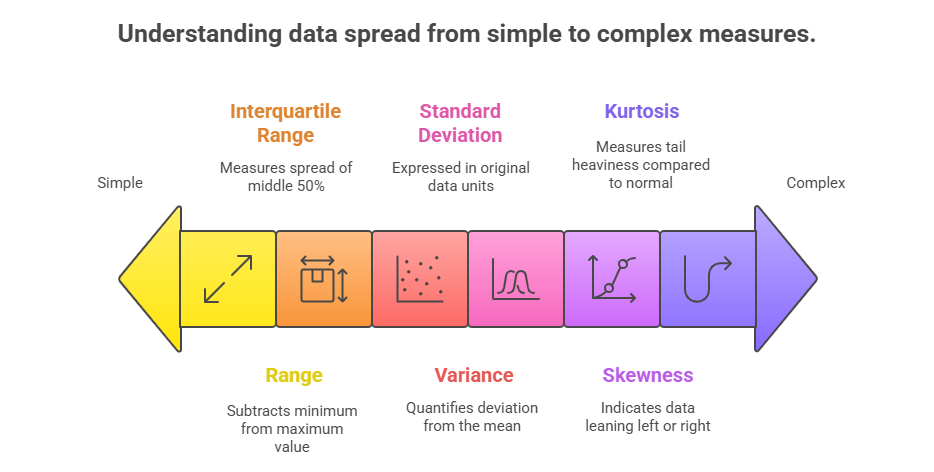
The range merely takes the difference between the maximum and the minimum. When the customer satisfaction scores lie between 2 and 10, the range will be 8 meaning that there will be a high difference in the experiences of customers.
Standard Deviation and Variance
These tests are used to measure the distance between the individual data points and the means. An increased standard deviation is an indication of increased variability. An example is a study on customer behavior where it was established that businesses that had high customer spending standard deviation required various marketing approaches compared to the companies that had balanced customer spending behaviors.
The reason why standard deviation is so handy is that it is available as a measurement of the same units as the data being measured. With average monthly revenue of 100,000 and standard deviation of 15,000, you can right away realize the normal range of variation.
Interquartile Range (IQR)
The IQR is used to quantify the dispersion of the middle half of the data, which is used to get rid of the extremes. It is invaluable, therefore, in detecting outliers in business statistics applications such as fraud detection or quality control.
Shapes of Distribution in Descriptive statistics
These statistics explain the general trend and symmetry of your data.
Skewness
The skew shows the direction of the data i.e. whether it is left or right. The distribution of incomes are usually positively skewed during which majority of the workforce have moderate incomes and a handful of executives have high incomes. Knowledge of skewness aids companies in making realistic goals and remuneration packages.
Kurtosis
Kurtosis is used to compare the data to a normal distribution in terms of heavy tails or light tails. A high kurtosis implies that there are also extreme values that occur very frequently that are crucial in risk management and financial planning.
Real-life examples of using Descriptive Statistics in Business
We shall look at the application of these concepts by various business functions in real life situations.
Financial Performance Analysis
Descriptive statistics are applied by financial teams to monitor key performance indicators (KPIs) and trends. For example:
- Estimating average quarterly revenue growth.
- Comparing changes in monthly expenses in order to make budgeting better.
- Setting achievable targets in product lines based on median profit margins.
The manufacturing firm could trace the standard deviation of manufacturing expenses to determine when the costs are unpredictable and this is an indication that the company is about to encounter a supply chain challenge.
Human Resources and Workforce Management
| HR Metric | Statistical Measure | Business Application |
| Employee Satisfaction | Mean score | Overall workplace morale assessment |
| Salary Benchmarking | Median salary | Fair compensation determination |
| Turnover Analysis | Percentage & variance | Retention strategy development |
| Performance Reviews | Standard deviation | Identifying high/low performers |
Using the difference in employee performance scores, the HR can tailor the development programs to various levels of skills instead of providing the desiccant training.
Quality Control and Operations
Descriptive statistics helps the operations managers in optimization of processes. To ensure quality, manufacturing plants monitor the mean production times and standard deviations. In a similar way, the service industries observe the average response time and the distribution of the time that the customers wait so as to optimize operations.
Designing Useful Visualizations in Descriptive statistics
Raw figures do not give the whole story. As a result, converting descriptive statistics into graphs would help to access insights to stakeholders at both levels.
Common Visualization Types:
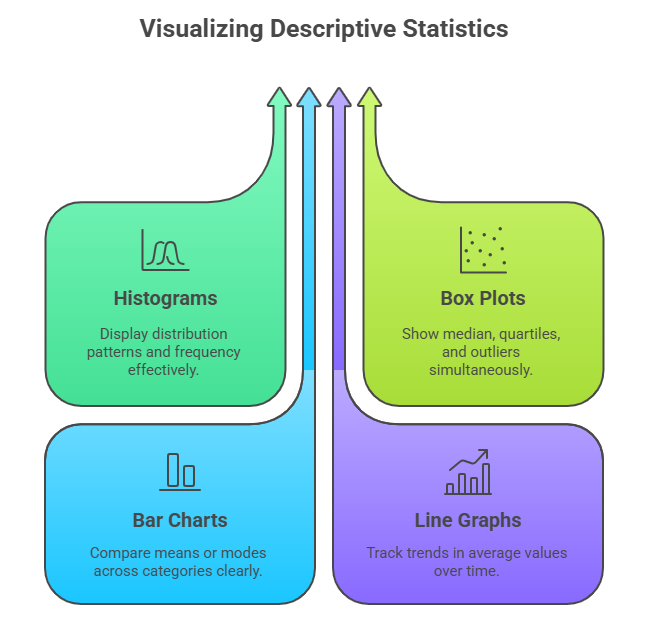
- Histograms: Illustrate patterns and frequency of distribution.
- Box plots: Show outliers, median, and quartiles at the same time.
- Bar charts: Compare means or mode across categories.
- Line graphs: Monitor trends of average values with time.
What is more, according to data visualization research, individuals can retain 80 percent of information on a visual over 20 percent of text-based data, which is why the combination of descriptive statistics and enticing graphics can facilitate improved business decision-making.
Common Mistakes to Avoid in Descriptive statistics
Descriptive statistics are misused even by the experienced professionals. These are some of the pitfalls that should be avoided:
Relying Solely on Averages
The mean is deceptive in the case of outliers. It is always good to consider more than one measure such as the mean, median, and mode which give the whole picture.
Ignoring Sample Size
Small samples give incapable statistics. A corporation that received feedbacks of only 10 customers can not make significant conclusions about the thousands of customers.
Baffling Correlation with Causation
Descriptive statistics displays associations, but does not demonstrate cause and effect. The fact that the sales have grown following a marketing campaign does not necessarily imply that the marketing campaign was the cause of the growth.
Overlooking Data Quality
The saying goes that, as garbage in, so garbage out. Hence, proper correct data collection is the prime requirement prior to the application of any statistical analysis.
Getting Started with Descriptive Statistics
Are you prepared to put these ideas into practice? Here’s your action plan:
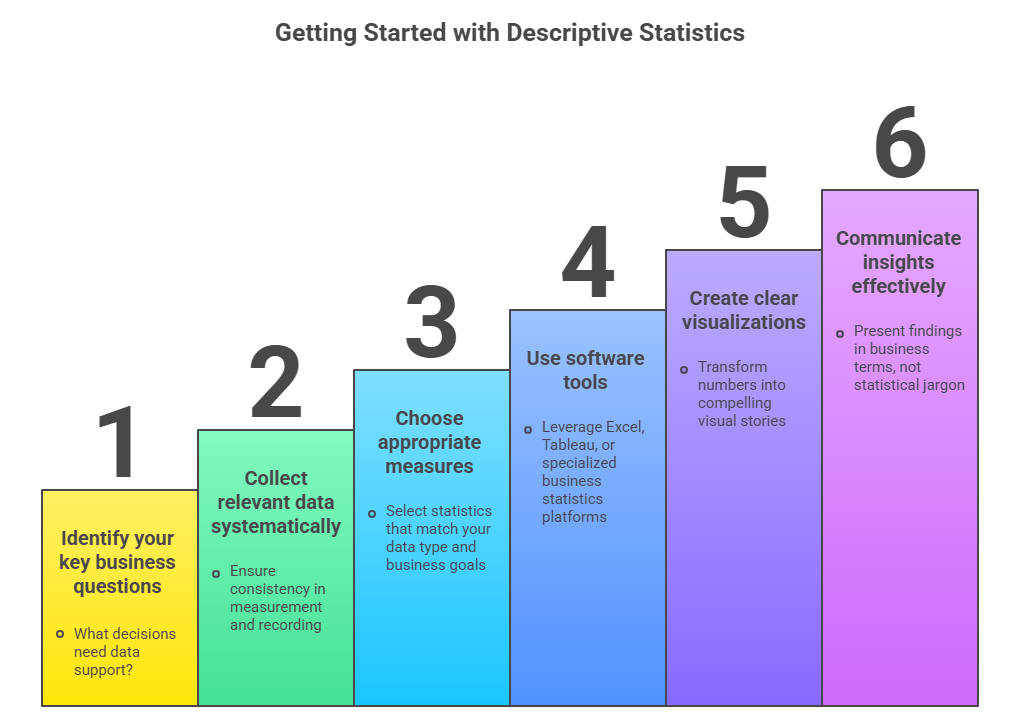
- Find your business questions: What are your critical business questions?
- Gather the appropriate information in an orderly fashion: Be consistent in measurement and documentation.
- Select the right measures: Select statistics that fit your business objectives and type of data.
- Apply software tools: Automate calculations by using Excel, Tableau, or business statistics tools.
- Make visuals comprehensible: Turn numbers into attractive visual narratives.
- Share knowledge well: Be able to present results in business, not statistical language.
Moreover, numerous free online materials and programs can expand your statistical knowledge, and thus, these effective tools are available to any professional.
Conclusion: Data to Competitive Advantage
The basis of data-driven decision-making in the contemporary business is descriptive statistics. With the understanding of measures of central tendency, variability, and distribution, you are able to derive useful information out of the raw data as effectively as possible.
It is important to note that it is not the tricky formulas that help one succeed in using business statistics but rather posing the right questions and picking out the right tools to respond to the questions. Descriptive statistics helps you to gain the clarity to make sound decisions whether it is the analysis of sales performance, customer behavior or optimization of operations.
Begin with one important metric in your job and put these ideas into a systematic use. The more you increase your statistical literacy, the more you will make a contribution towards ensuring organizational success.
Which business problem do you want to solve using the descriptive statistics first? Please leave your testimonies below and make sure to subscribe in order to receive more information that will change the way you work!