
Introduction: The BCG Matrix.
Imagine the following: You are dealing with numerous products each requiring resources, attention, and investment. Which of them are worthy of your attention? Which should you phase out? The BCG Matrix here is your strategic guide.
The BCG Matrix is one of the most potent portfolio analysis tools that are developed by the Boston Consulting Group in the 1970s. An entrepreneur or CEO of a Fortune 500 corporation, this framework will help you to use your resources strategically and to increase your profitability and to achieve sustained growth.
We are going to take a deeper look at the BCG Matrix and understand its operation, four quadrants, its practical use, and how it can be applied in practice to change your business portfolio. You will also learn pitfalls to avoid and tips of the experts to implement.
What Is the BCG Matrix?
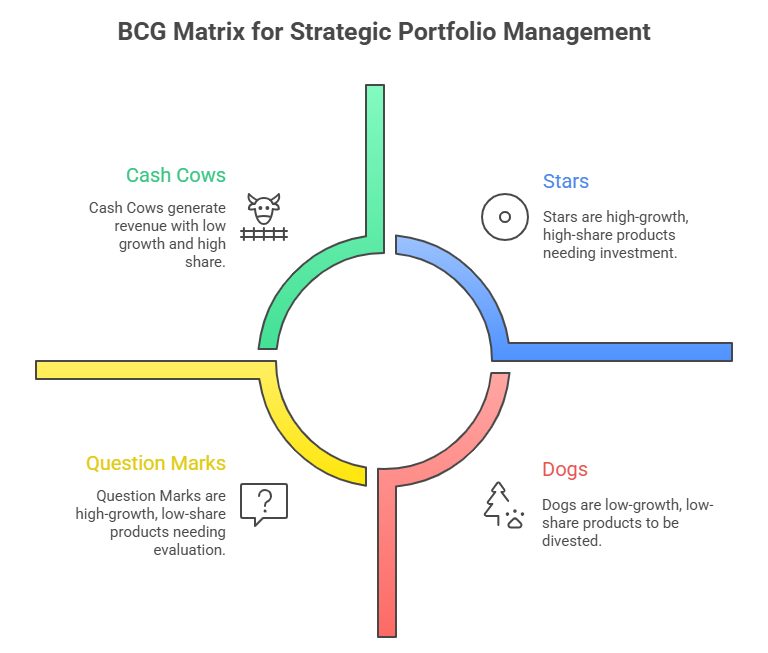
BCG Matrix or the Growth-Share Matrix is a strategic planning tool that assesses the portfolio of products of a company on two important bases:
- Market Growth Rate (vertical axis): Refers to attractiveness in the industry and its growth potential.
- Relative Market Share (horizontal axis): Determines position of competition against the biggest competitor.
Using this 2×2 grid, where products or business units are plotted, companies are able to know where to invest or divest, or sustain their resources. On top of that, this visual system helps to simplify complicated portfolio choices into action plans.
An Explanation of the Four Quadrant BCG Matrix.
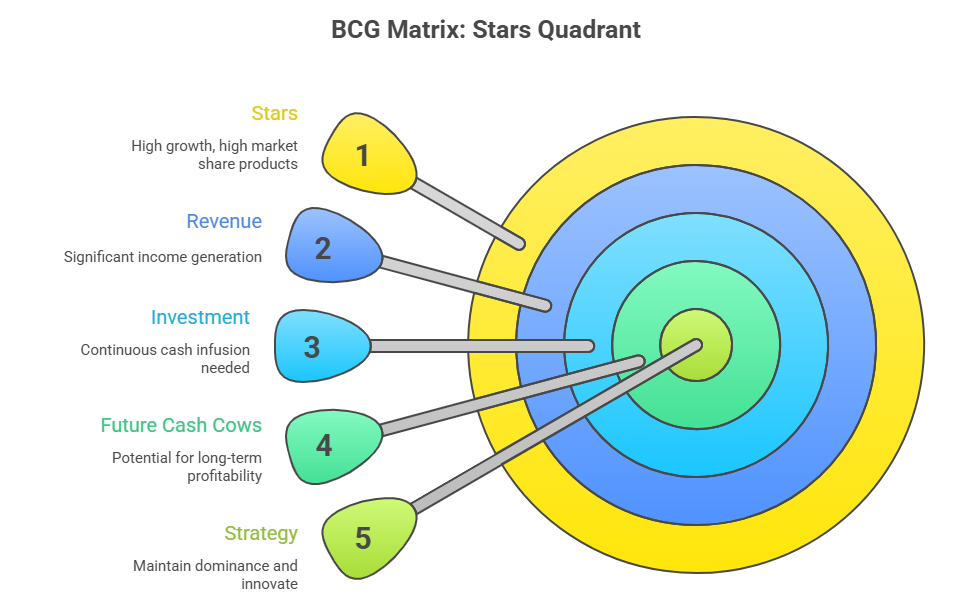
Stars: High Growth, High Market Share.
Stars are your best potential products. They have a good competitive position and they work in fast-growing markets. Therefore, these products are expensive to maintain growth and keep away competition.
Characteristics:
- Achieve high revenues.
- Needs capital investment on a regular basis.
- Potential Cash Cows of the future.
Scenario: When iPhone was in its infancy, Apple was at the top of the smart phone market with the industry registering a high level of growth. In order to remain a leader, the company spent a lot of money on R&D, marketing and production capacity.
Strategy: Continue vigorous investment to dominate the market. Moreover, concentrate on innovation and brand building to move to Cash Cows when the growth of the market decelerates.
Cash Cows: Low growth, High Market share.
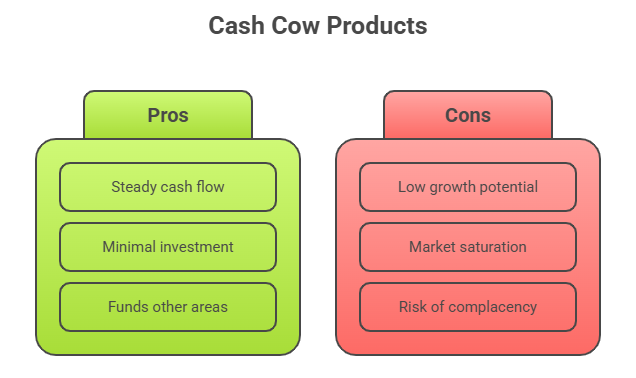
Cash Cows are established products that occupy a leading position in the market of slow growth. These horses are cash generators that require minimal capital.
Characteristics:
- Generate greater cash than they are spending.
- Compete in advanced and stable markets.
- Invest in funds in other areas of the portfolio.
Case Study: The flagship drink of Coca-Cola controls the cola industry with little growth in the industry. The product has minimal marketing outlay and it has brought in billions of profit every year.
Strategy: Extract profits to invest in Stars and Question Marks. In the meantime, remain in the market with minimum investment at maximum cash generation.
Question Marks: High Growth, Low Market Share.
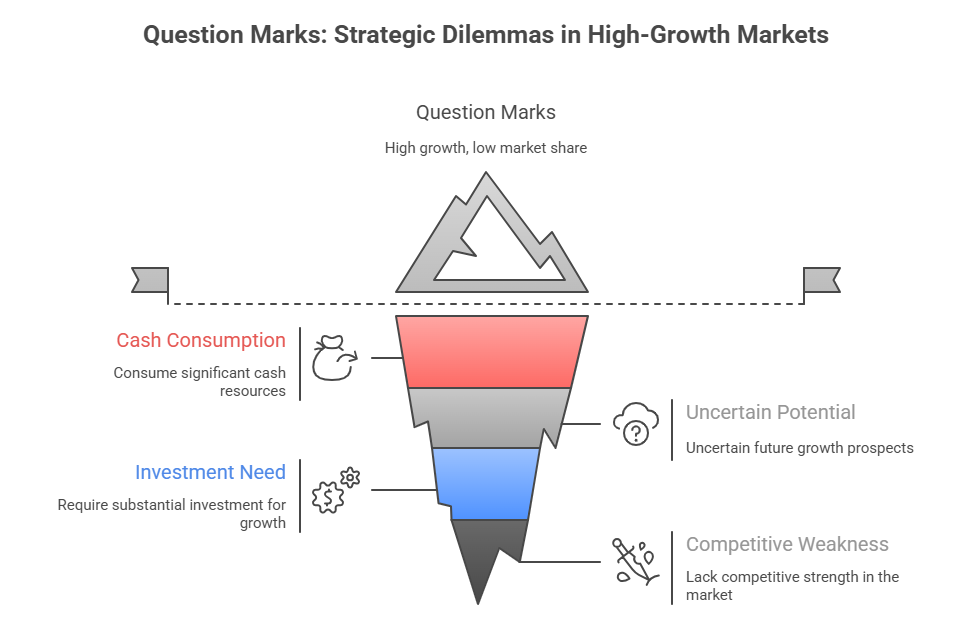
Question Marks (also known as Problem Children) are present in high-growth attractive markets, but are small competitors. Thus, they are the strategic dilemmas to be evaluated.
Characteristics:
- Consume significant cash
- Uncertain future potential
- Requires a lot of investment to win market share.
Scenario: There are numerous electric car startups in the electric vehicle market which are competing, but cannot counter the Tesla dominance. These companies have to make life or death choices regarding further investment or getting out of the market.
Strategy: Selective investment in Question Marks that have the best potential of becoming Stars. Otherwise, shed off those that are not likely to give it a competitive advantage. Harvard Business Review recommends that companies should subject these investments to strict guidelines when appraising them.
Dogs: Low Growth, Low market share.
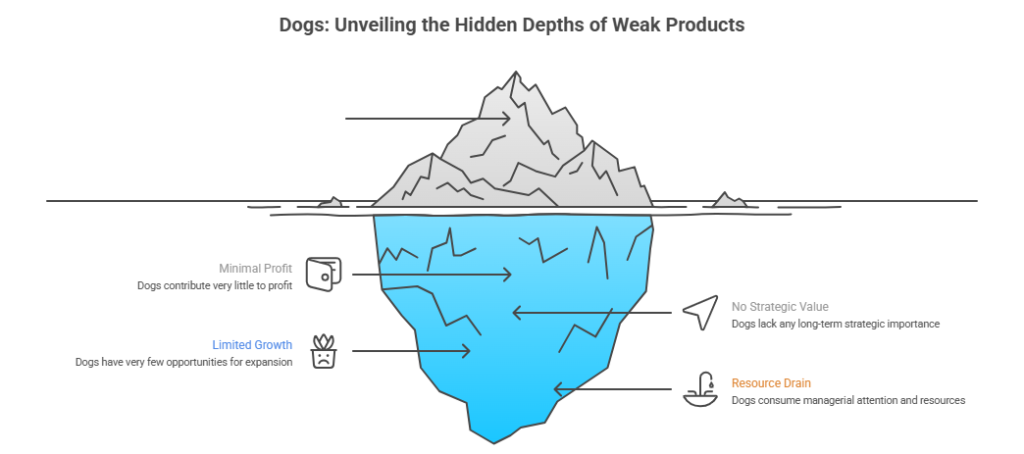
Dogs are unappealing products in unattractive markets. They do not produce or consume meaningful cash, literally burning the management time and resources.
Characteristics:
- Low contribution to profits.
- No strategic value
- Limited growth prospects
Example Blackberry smartphones became Dogs since they lost market share to iPhone and Android in a maturing smart phone market.
Strategy: Divest, discontinue, or extract the remaining value at little investment. But think about niche opportunities in which Dogs may be profitably sold to a certain group of customers.
The Way to Construct Your own BCG Matrix.
Step 1: Find Your Product Portfolio.
Identify products, services or business units you would like to analyze. To achieve maximum effectiveness, only those that have enough revenue should be considered strategic.
Step 2: Determine Growth rate of Markets.
Calculate the percentage yearly growth of each market based on industry reports and market research information. Generally, the growth rate of over 10 is a sign of high growth markets.
Step 3: Evaluate Relative Market Share.
Divide your market share with that of your biggest competitor. A ratio of above 1.0 demonstrates leadership in the market and a ratio of below 1.0 shows poor competitive status.
Step 4: Position the Products on the Matrix.
Place every product according to its coordinates. Portfolio balance and strategic priorities are immediately seen in this visual representation.
Step 5: Develop Action Plans
Develop unique plans per quadrant with resources being allocated based on strategic value and growth potential.
Real life Applications and Success Cases.
Technology Giants.
Companies such as Microsoft frequently make use of portfolio analysis tools. As an example, they have managed to migrate products of Question Marks to Stars (Azure cloud services) and sell Dogs (Windows Phone).
Consumer Goods Leaders.
Procter & Gamble has comparable structures in the management of its more than 65 brands. They have identified the Dogs and redistributed the resources to the Stars and Cash Cows, which have made their portfolio more profitable.
Retail Industry.
Amazon always tests new opportunities with the help of a matrixed mind. Therefore, they have canceled failed projects (Fire Phone) and had to expand successful ones (AWS, Prime).
The Benefits of the BCG Matrix.
The BCG Matrix has a number of strong advantages:
- Visual Simplicity: Portfolio decisions that are complex are comprehended at first glance.
- Resource Optimization: Smart direction on how to invest in products.
- Strategic Focus: This is where products that are worthy of attention and those that are not.
- Objective Analysis: Less emotional attachment to products that are not performing well.
- Communication Tool: Enables board level deliberations on portfolio strategy.
In a study conducted by McKinsey & Company, it was found that companies that have applied structured portfolio analysis have 15-20 percent higher efficiency in resource allocation.
Common Limitations and How to Overcome Them.
Oversimplification
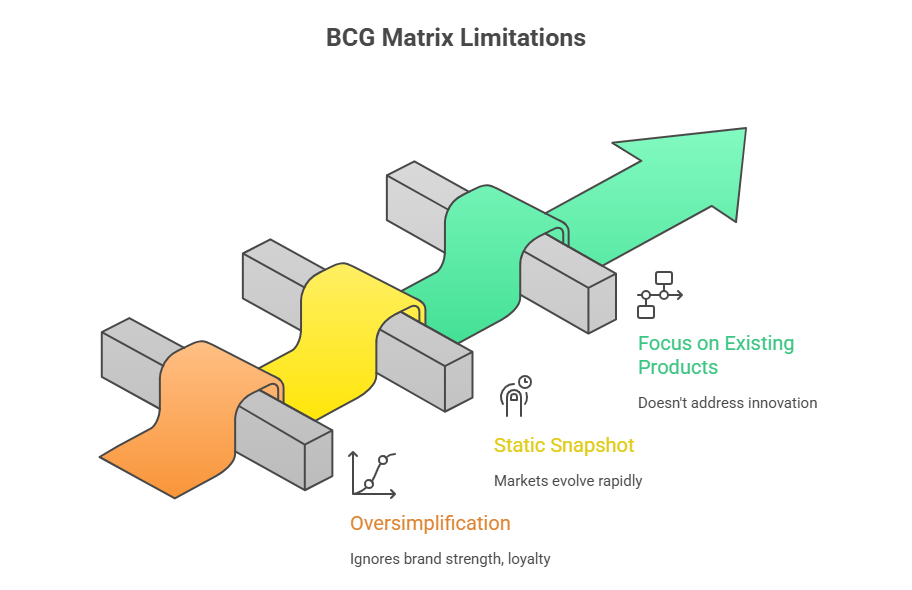
The two dimension structure does not take into account such variables as brand strength, customer loyalty, and product/product synergies.
Resolution: Add more analysis tools such as SWOT analysis and competitive benchmarking.
Static Snapshot
Markets change fast but BCG Matrix captures a single point in time.
Resolution: Have your matrix updated quarterly and keep an eye on market dynamics.
Focus on Existing Products
The framework is not concerned with innovation or new product development.
Resolution: Integrate with innovation structures and have a different pipeline on new opportunities.
Next Generation BCG Matrix Strategies.
Portfolio Balancing.
Have healthy distribution across quadrants. Ideally, use Cash Cows to make cash, investment in Stars, Question Marks should be carefully evaluated, and Dogs should be reduced.
Strategic Sequencing.
Investments should be timed. As an illustration, cash cow profits can be harvested before decreasing and Question Marks may be invested in before the competitors can become dominant.
Refining of the market definition.
Establish markets in a narrow way that allows analysis to be meaningful but in a broader way that allows the inclusion of strategic alternatives. The balance has a great influence on the locations of products on the matrix.
Combining BCG Matrix and Modern Business Tools.
The modern businesses integrate the BCG Matrix with:
- Data Analytics: Do real-time portfolio tracking with Tableau or Power BI.
- Financial Modeling: Model the relationship between cash flow projections and ROI.
- Agile Methodology: Implement quarterly instead of annual review of portfolio.
- Customer Analytics: Add customer lifetime value and customer retention measures to measurements.
Conclusion: Turn Your Portfolio Strategy around.
The BCG Matrix is extremely relevant even in 2025, since it was created more than 50 years ago. Its lasting merit is that it makes hard to discuss the distribution of resources and priorities of the strategy.
Knowing your Stars, Cash Cows, Question Marks and Dogs, you will be able to make wise decisions that will lead to sustainable growth. What is more, an integration of this framework with the modern analytics and complementary tools presents an effective strategic benefit.
Begin with mapping your portfolio now. Determine what products should receive more investment, which ones should receive no more funding, and which ones require decisive measures. It is worth remembering that strategic clarity is the difference between market followers and leaders.
Take Action Now
Are you willing to streamline your product portfolio? Start by downloading our free BCG Matrix template and graph your products. Next, add your wisdom to the comment box–we would like to know how you are putting these strategies into practice.
To learn more about the strategic directions, read more about competitive analysis, market segmentation and growth strategies. A step at a time towards a portfolio excellence begins with a single strategic decision.