
Introduction: Why Strategic Management Makes -or Breaks-Your Business.
Imagine this: Two companies open up shop in the same industry with similar resources. Five years later, one is preeminent in the market and the other is struggling to survive. What’s the difference? The answer is to strategic management.
In the current hyper-competitive business world, winging it just doesn’t fly. Strategic management is the roadmap that helps turn your vision into reality while helping you manage market disruptions, huge competition and achieve sustainable growth. Whether you’re at the helm of a startup or running an enterprise, becoming well-versed in strategic management is not an option-it’s a requirement.
This guide will walk you through all you need to know about strategic management from the basics to the practical implementation strategies. You’ll find out what frameworks work, gain knowledge from real-world examples and get practical knowledge to transform the performance of your organization.
What Is Strategic Management? Understanding the Foundation.
Strategic management is the systematic process of defining your organization’s direction, making decisions regarding the allocation of resources, and taking actions to accomplish long-term goals. Think of it as your business GPS – a constant analysis of where you are and where you want to go and the best route to get there.
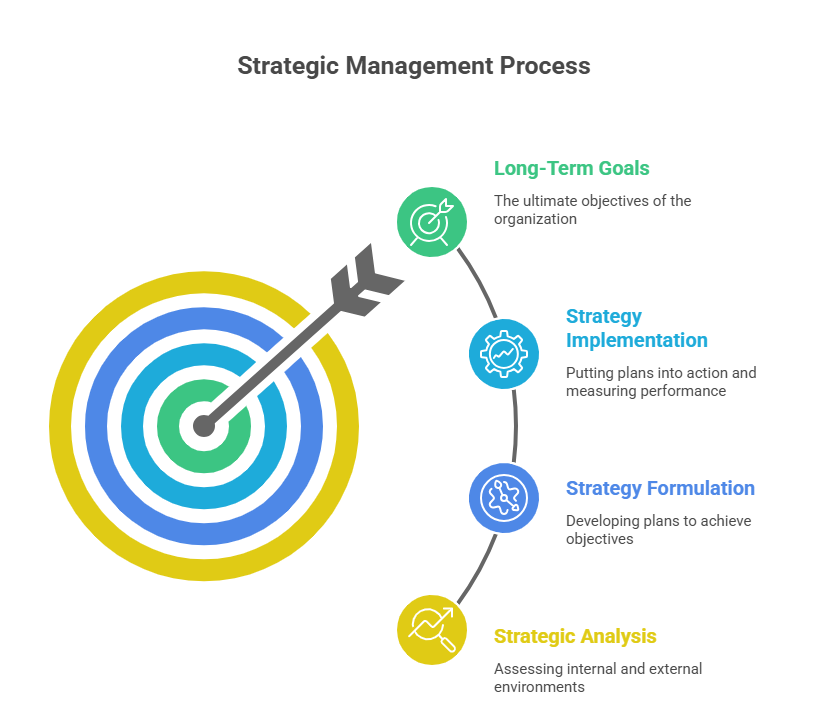
At its core, strategic management comprises of three critical elements;
- Strategic Analysis focuses on analysis of your internal abilities and external environment. This involves knowing your strengths and weaknesses, opportunities and threats and staying tuned into market trends, competitive trends and industry movements.
- Strategy Formulation is the translation of analysis into plans of action. Here, you set up your mission, vision and specific objectives, then develop strategies for achieving the objectives. This phase answers the important question: “How will we compete and win?”
- Strategy Implementation turns plans into action by implementing them in concrete activities, allocating resources, and measuring performance. Even the brightest strategy is ineffective without good execution.
According to a study conducted by Harvard Business Review, only 8% of leaders are good at both crafting and implementing strategy – which is one of the reasons why learning the entire strategic management process gives you a huge competitive edge.
The Strategic Management Process: A Step-By-Step Framework.
Successful organizations follow a structured strategic management process in order to achieve alignment and outcomes. Here’s how it works:
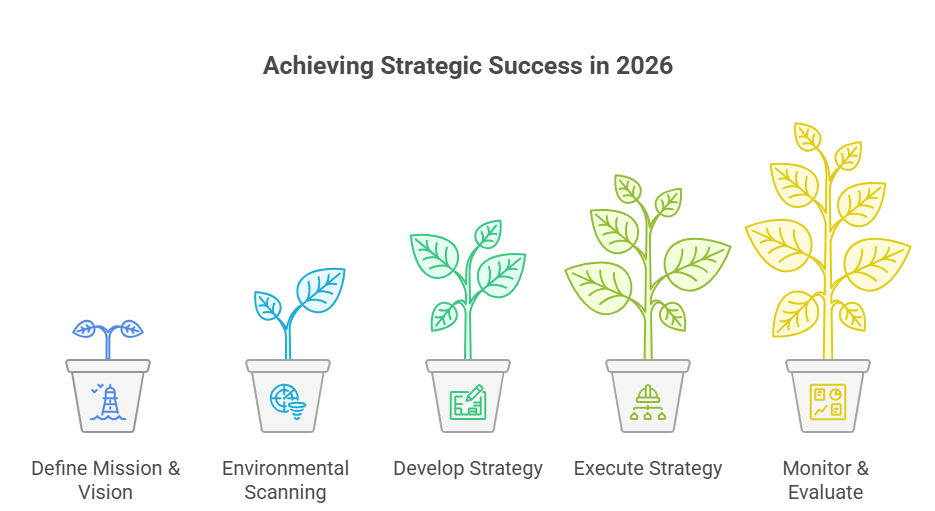
Step 1: Define Your Mission and Your Vision.
Your mission statement explains why your organization exists, whereas your vision explains where you’re going. These underlying elements give purpose and direction to every strategic decision:
For example, the mission of Tesla, “to accelerate the world’s transition to sustainable energy,” informs everything from the development of its products to the expansion of its market. This clarity helps employees, investors and customers understand what the company stands for.
Step 2: Performed Environmental Scanning.
Environmental scanning is the process of systematically monitoring for internal and external factors, which affect your business. Use tools such as SWOT analysis (Strengths, Weaknesses, Opportunities, Threats) and PESTLE analysis (Political, Economic, Social, Technological, Legal, Environmental) to collect complete information.
The most important aspect is to look beyond trends that are obvious. What regulations are likely to change and disrupt your industry? Which new technologies may open up new opportunities? McKinsey research shows that companies who carry out thorough environmental scans are 2.5x more likely to outperform their competitors.
Step 3: Develop Your Strategy.
Strategy formulation involves selecting how you’re going to compete. There are three general approaches to competition based on Michael Porter’s generic strategies framework:
Cost Leadership: Becoming the low-cost provider in your industry (think Walmart or Costco)
Differentiation: Provide some unique value that commands premium pricing (like Apple or Rolex)
Focus Strategy: Targeting a specific niche market with special offerings
Your selected strategy should make use of your strength while filling market gaps that your competitors have not.
Step 4: Execution of Your Strategy.
Implementation brings strategic plans to operational reality. This involves:
Resource Allocation: Focusing capital, talent and technology on strategic priorities. Research from Bain & Company shows that companies dynamically reallocating resources create 30% greater total returns to shareholders.
Organizational Alignment: Ensuring organization structure, culture, and systems support strategic goals. This may involve reorganizing teams, making process updates, or investing in new capabilities.
Change Management: Effective communication of the strategy and managing the human side of change. Studies show that 70% of change initiatives fail because of employee resistance and lack of management support.
Step 5: Monitoring and Evaluate Performance.
Strategic management isn’t a one-time event – it’s a continuous cycle. Establish key performance indicators (KPIs) that measure progress towards strategic objectives. Review these metrics on a regular basis and change course when necessary.
The balanced scorecard approach was developed by Kaplan and Norton and offers a comprehensive approach of measuring the performance using four perspectives (financial, customer, internal process and learning).
Important Strategic Management Tools and Frameworks.
Having the proper analytical tools gives your strategic management a boost:
Porter’s Five Forces Analysis.
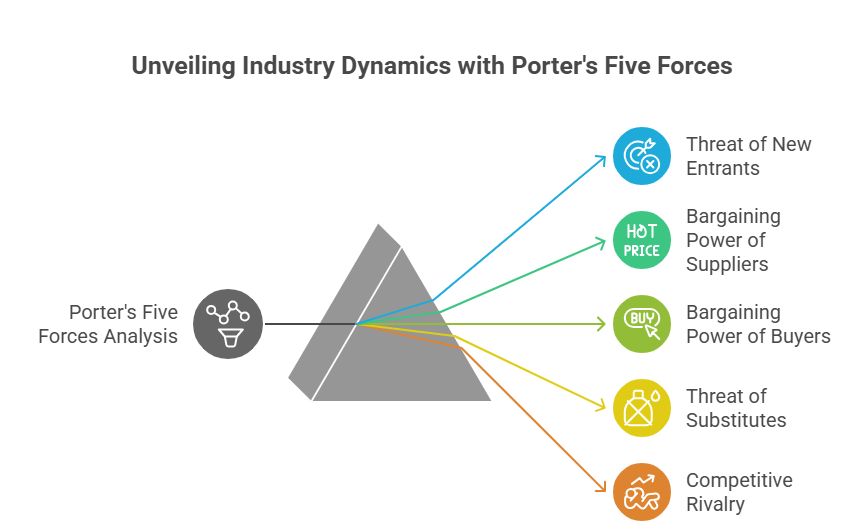
This framework assesses the attractiveness of the industry by examining five competitive forces: threat of new entrants, bargaining power of suppliers, bargaining power of buyers, threat of substitutes, and competitive rivalry. Understanding these dynamics helps you to position your organisation strategically.
BCG Growth-Share Matrix.
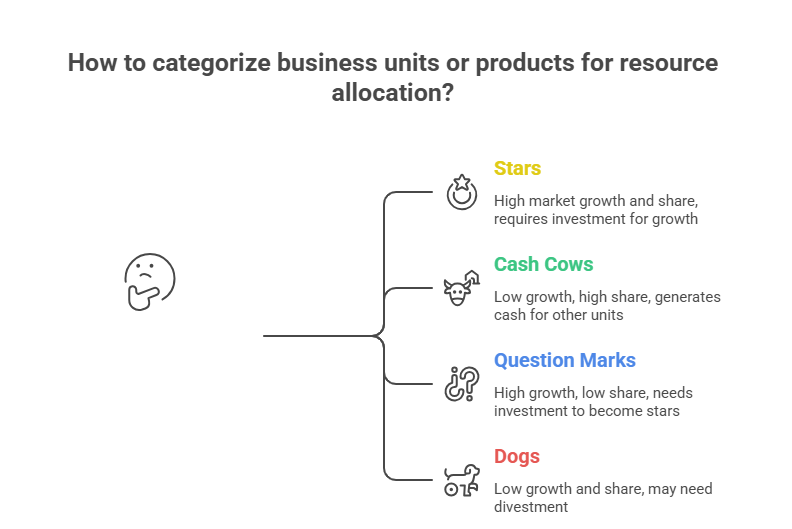
The Boston Consulting Group matrix is a way of categorizing business units or products into four quadrants – Stars, Cash Cows, Question Marks and Dogs – depending on market growth and relative market share. This visual tool is used to make resource allocation and portfolio management decisions.
Ansoff Matrix.
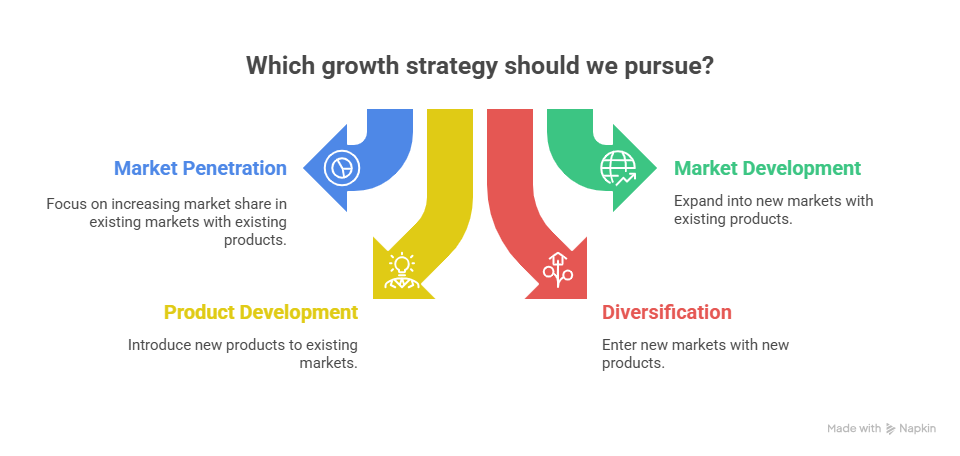
When designing growth strategies, the Ansoff Matrix offers four possibilities – market penetration, market development, product development, and diversification. Each has various risk levels and resource requirements.
Value Chain Analysis.
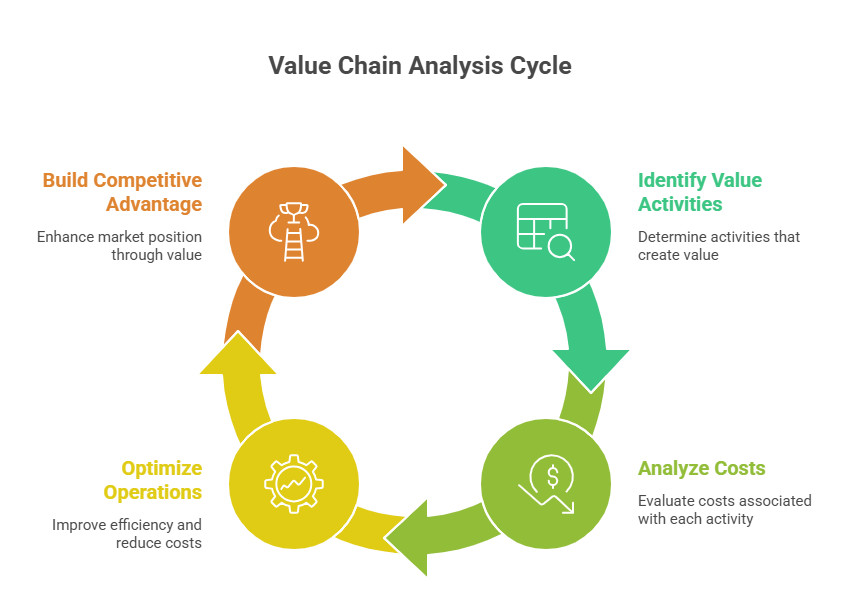
Developed by Michael Porter, value chain analysis focuses on activities your organisation performs to create value. By determining where you generate the most value and where you are overspending, you can optimize operations and build competitive advantage.
Real Life Strategic Management Success Stories.
Learning from companies that have gotten strategic management right offers valuable lessons:
Netflix’s Strategic Pivot Netflix had initially started their business by mailing DVDs but realized streaming technology would disrupt their business. Rather than sticking to their successful model, they made strategic pivots to streaming, then content production. This bold approach to strategic management helped them to transform themselves from a DVD rental service into a $150 billion entertainment giant.
Amazon’s Customer-Centric Strategy: Jeff Bezos built Amazon around the unwavering strategic focus on customer obsession. Every decision – from the development of AWS to the Whole Foods acquisition – is consistent with their strategy of being Earth’s most customer-centric company. This consistency has made Amazon one of the most valuable brands in the world.
Microsoft’s Cloud Transformation Under CEO Satya Nadella, Microsoft moved from being a PC-centric company to cloud-first and mobile-first. This strategic reorientation, announced in 2014, expanded Azure into a leader in the cloud platform space and tripled Microsoft’s market value. The lesson? Strategic management requires courage to let go of the legacy business models when the future is demanding it.
Common Strategic Management Pitfalls And How to Avoid Them.
Even seasoned leaders falter when it comes to carrying out strategic management. Here Are Common Mistakes and Solutions:
Pitfall 1: Strategy But No Execution.
Creating impressive strategic plans that never become results is remarkably common. Bridge the strategy-execution gap by establishing clear accountability, setting specific milestones and staying dogmatic about implementation.
Pitfall 2: Neglecting External Changes.
Markets evolve rapidly. Companies that fail to pay attention to changing customer preferences, new technologies, or competitive threats are blindsided. Institutionalize environment scanning by regularly analyzing competitors and doing market research.
Pitfall 3: Not Being Strategically Communicative.
Your strategy can’t work if you don’t have the buy-in of your team. According to research mentioned by Forbes, 95% of employees don’t understand or are ignorant of their company’s strategy. This needs to be fought against with consistent communication, storytelling, and the link to strategic objectives from day-to-day work.
Pitfall 4: Stiff Strategic Plans.
While having a strategic plan is essential, having a strategic plan that is unchangeable is dangerous. Build flexibility into your strategic management approach Review and adjust strategies on quarterly basis according to performance data and market conditions.
Building Your Strategic Management Capabilities.
Developing good strategic management skills takes conscious effort:
Cultivate Strategic Thinking: Look Beyond Day-to-Day Operations: Consider long-term implications. Ask yourself the question: “Where is our industry going?” What are the capabilities that we will require in 3 years? How might our competitive landscape change?”
Embrace Data-Driven Decision Making: Make strategic decisions based on sound data, not just hunch. Invest in analytics capabilities with the ability to deliver actionable insights about customers, markets, and operational performance.
Foster Collaborative Strategy Development: The Best Strategies Are Derived from Diverse Perspectives. Include voices from different departments, levels and backgrounds in your strategic planning process.
Invest in Continuous Learning: Strategic management is dynamic and changes with the changing business environments. Stay in the loop by reading Harvard Business Review, attending strategy conferences and learning from thought leaders in the field.
The Table of Comparison of Strategic Management.
| Strategic Approach | Best For | Key Advantage | Primary Risk |
| Cost Leadership | High-volume industries | Price competitiveness | Race to bottom |
| Differentiation | Quality-focused markets | Premium pricing power | Imitation by competitors |
| Focus Strategy | Niche markets | Deep customer understanding | Limited growth potential |
| Blue Ocean Strategy | Innovative companies | Uncontested market space | Execution complexity |
Conclusion: Your Strategic Management Action Plan.
Strategic management isn’t a practice reserved for Fortune 500 companies – it’s a vital practice for any organization with serious ambitions for long-term success. By systematically analyzing your environment, developing well thought out strategies, implementing with discipline and constantly monitoring results, you put your business in a position to thrive regardless of market conditions.
Here are some takeaways from the discussion:
Strategic management is a process and it is an on-going process, not an event that occurs once
Successful strategy requires not only brilliant formulation but flawless execution too
The best strategies utilize your unique strengths whilst meeting real market needs
Regular evaluation and adjustment to keep your strategy relevant as conditions change
Start building strategic management today with a comprehensive SWOT analysis of your organization. Identify one strategic priority that could make a dramatic difference to your business and then develop a 90-day plan of action to act on it.

What strategic challenges is your organization facing?
Share your thoughts in the comments below, and let’s discuss how strategic management principles can help you overcome them. Don’t forget to subscribe for more insights on building winning business strategies.