
Introduction: The Five Forces Every Business Leader should Have.
Imagine the following: You are about to introduce a new product, but you do not even know whether your industry is a goldmine or a battlefield. What is the intensity of the competition? Are You Margin -Squeezed by suppliers? Will the customers insist on bottom-price? The following questions are the ones that keep businessmen and business executives awake at night. Luckily, there is an established structure to the answer to them called Porter’s Five Forces model.
Porter’s Five Forces is a very strong analytical model that assists corporations in comprehending the rivalry and undertaking sounder strategic decisions. It is a framework that was developed by Michael Porter, a professor of Harvard Business School in 1979 and has since formed the basis of competitive analysis across the globe. Every founder of a startup considering entering the market, or an experienced executive defining your strategy, you can use the lessons about Porters Five Forces to change your approach to competition and how you win.
We will devote all of these five forces in this all-inclusive guide, where we will demonstrate how to use each of the five forces into practice and offer practical tips that will enhance your competitive advantages. Let’s dive in.
What Are Porter’s Five Forces?
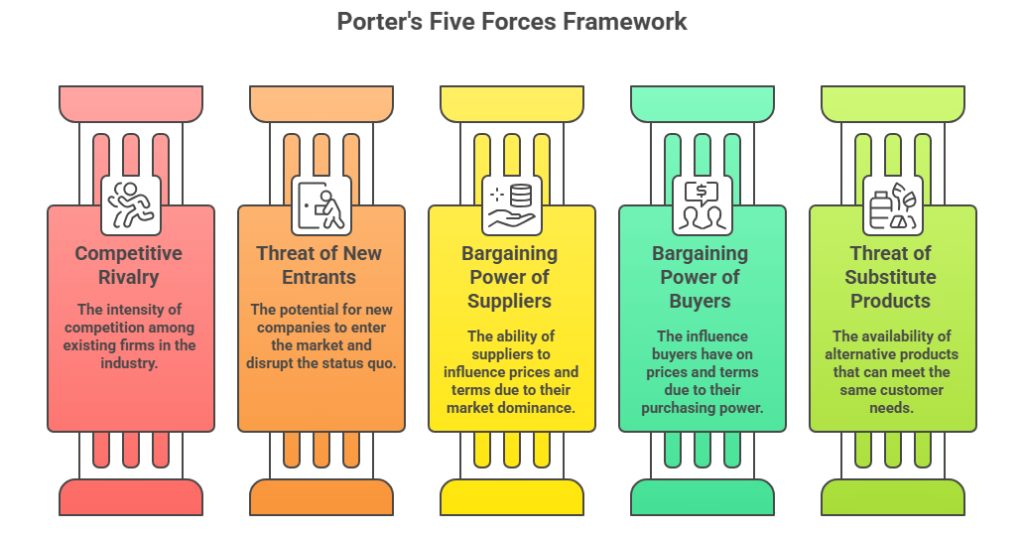
Porter’s Five Forces is a model which examines the level of industry rivalry and appeal. This model does not merely consider direct competitors but focuses on five aspects that determine the competition and profitability:
- Competitive Rivalry – Competitiveness among the existing players.
- Threat of New Entrants-Ease of market entry by new competitors.
- Bargaining Power of Suppliers – The extent to which suppliers influence the prices.
- Bargaining Power of Buyers – The degree to which the customer determines prices.
- Threat of Substitutes – The experienced risk of customers going to alternative solutions.
The combination of these forces can either ensure that an industry is an attractive location in terms of profit potential or be a major challenge. Besides, they assist companies to find out where they can achieve benefits and where they have to protect themselves.
Force 1: Competitive Rivalry in Porter’s Five Forces – Knowing Your Close Competitors.
Competitive rivalry looks at the level of competition amongst the established companies within your industry. Therefore, intense competition often implies the decreasing level of profit and increased business aggression.
What fuels Competitive Rivalry in Porter’s Five Forces ?
Competition in an industry is heightened by a number of factors:
Competitors Competitors in industries with similar size competitors are likely to be competitive. In the case of the restaurant industry, the competition is fierce because of the presence of millions of restaurants competing over the clientele.
Industry Growth rate: slow growing industries compel companies to take the market share away of other companies instead of enjoying overall growth.
Product Differentiation: In the case of commoditization of products, price is the primary battleground. Consider the case of the airline business where seats in the economy are practically the same.
Exit Barriers: The cost of quitting an industry is too high, which traps the struggling firms and keeps them over-capacity and low prices.
A study that was conducted by the Harvard Business Review reported that competitive rivalry in industries that have high competition compresses profit margins by 15-25 percent as compared to less competitive industries.
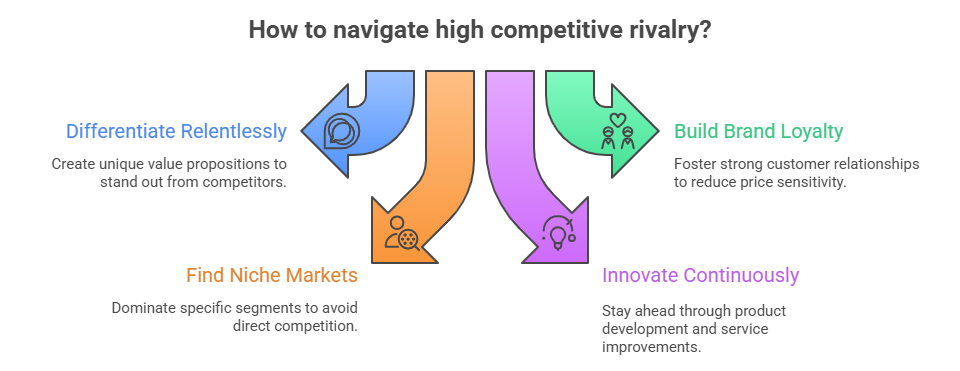
How to Navigate High Rivalry.
In order to perform in very competitive environments, the following strategies should be considered:
Differentiate ruthlessly: Go the extra mile and develop value propositions that can be differentiated.
Develop brand equity: Relationships with customers make them less price sensitive.
Identify niche markets: Conquer certain segments instead of competing all the way.
Keep refreshing: Be ahead of others with product development and improvement of service.
This is brilliantly exhibited by Apple who has product innovation, ecosystem lock-in, and premium branding to ensure that they continue to make profits despite high competition in consumer electronics.
Force 2: Threat of New Entrants in Porter’s Five Forces – Guarding Your Market niche.
The threat of new entrants is an indicator of the ease of entry by the competitors to your industry. In case of low barriers to entry, profitability is easily eroded by new entrants. On the other hand, high barriers safeguard the established firms and their profits.
Key Barriers to Entry
Barrier knowledge would make you evaluate industry attractiveness:
Capital Requirements: In industries that need enormous initial capital investments (such as automobile manufacturing), the new entrants are automatically curtailed.
Economies of Scale: They are economies of scale that existing players with large volume have cost advantages not exhaustible at the entry stage.
Brand Loyalty: Strong brands generate the switching costs which defend market share.
Regulatory Requirements: Licensing, patents and regulations have the ability to bar potential competitors.
Access to Distribution: Incumbents have great edges based on existing relationships with distributors and retailers.
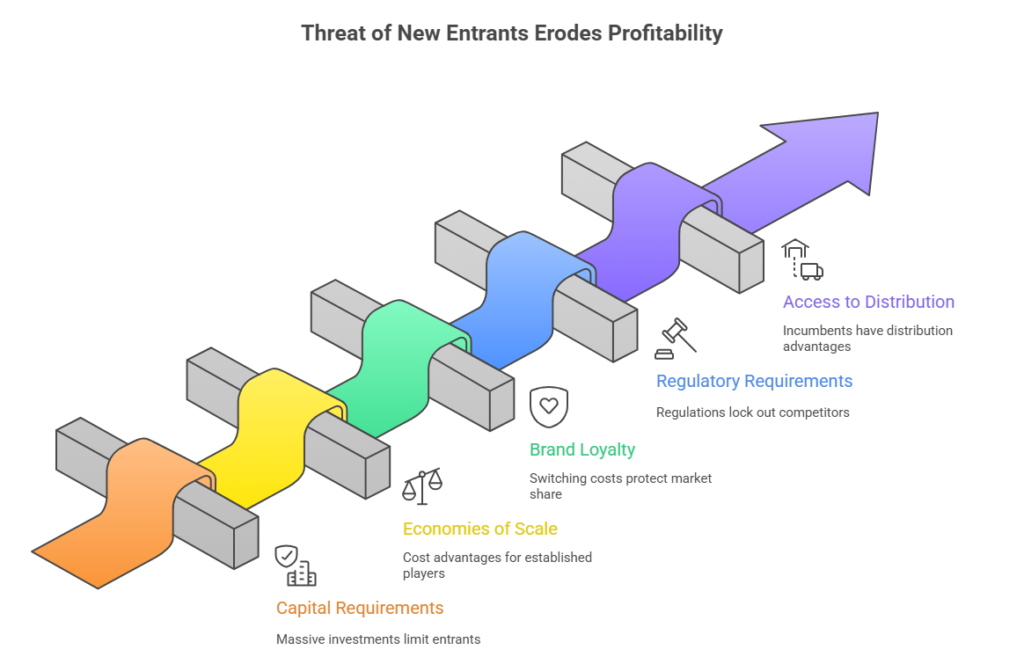
An example of a high barrier would be the pharmaceutical industry which has a difficult FDA approval process, costs of billions of dollars to research, and patent protection that may require 10-15 years to be navigated.
- Protecting against New Entrants.
- Smart companies move in advance, even in medium barrier industries:
- Invest into brand building, to build customer loyalty.
- Attain mono-supplier/distributor contracts.
- Constantly innovate in order to be technologically ahead.
- Take advantage of economies of scale to stay low the cost.
Force 3: Bargaining Power of Suppliers in Porter’s Five Forces- Managing Your Supply Chain.
The supplier power defines the degree of control exercised by suppliers on your prices and conditions. Powerful suppliers have the ability to increase prices, decrease quality, or restrict availability when they do this, it narrows your margins.
When Do Suppliers Hold Power?
Suppliers become powerful under a number of circumstances:
Few Substitutes: Little supplier power is high which makes them have high bargaining power.
Unique Products: Unique or proprietary inputs provide suppliers with pricing power.
High switching Costs: Relationships are expensive or complicated to break.
Forward Integration Threat: Suppliers that might present you with a direct competition are more powerful.
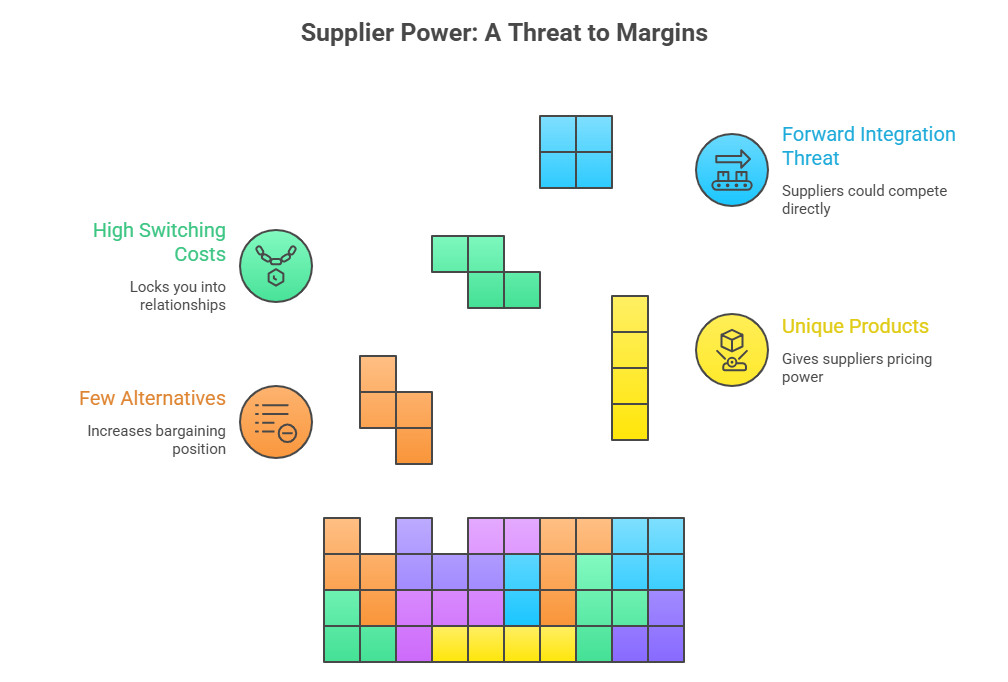
Take the case of the smartphone industry with firms such as Qualcomm being very powerful in that industry because of their proprietary chip technology with no many substitutes. Therefore, producers have to deal with the conditions of suppliers or face delays of products.
- Reducing Supplier Power
- Intelligent companies use a number of strategies:
- Have more than one supplier so as not to be dependent.
- Form long term relationships that are mutually beneficial.
- Where possible, build in-house capabilities in the key areas.
- Bargain volume purchasing at favorable prices and conditions.
This strategy is illustrated exactly by the move to have Tesla have battery production in-house with Gigafactories which will not only be less reliant on external suppliers but also increase margins.
Force 4: Bargaining Power of Buyers in Porter’s Five Forces- Customer Leverage Learning.
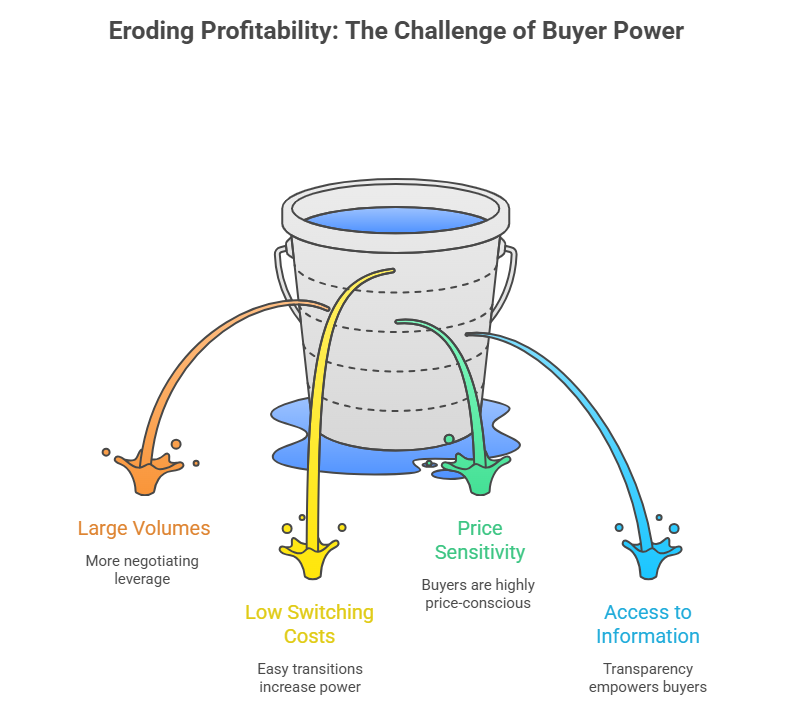
Buyer power is the degree of influence the customers have in terms and prices. More so, strong purchasers may insist on discounts, superior quality or superior service, which all lower profitability.
What Makes Buyers Powerful?
There are a number of factors enhancing the customer bargaining power:
High Purchase volumes: Buyers who correspond to high revenue enjoy greater bargaining power.
Low Switching Costs: The move between suppliers is easy hence raising buyer power.
Price Sensitivity: Commodity products render buyers very price-sensitive.
Information Availability: Accessibility of Comparison and Transparency enables customers.
The power of buyers in e-commerce has risen drastically with consistent price comparisons, reviews and switching of sellers in the e-commerce platforms such as Amazon. According to a study conducted by Statista, 87 percent of online buyers compare the prices before making a purchase, which is an escalation of competition.
- Managing Buyer Power
- So as to alleviate buyer leverage and safeguard margins:
- Establish switching expenses in the loyalty programs and integration of ecosystem.
- Make your offer differentiated to minimize direct competition.
- Create value relationships and not price relationships.
- Focus on less price sensitive clients.
This is what Software-as-a-Service (SaaS) companies are known to be good at, entrenching themselves deep in customer processes and making switching painful even when there is a subscription payment.
Force 5: Threat of Substitutes in Porter’s Five Forces – Surveillance of Disruption.
The threat of substitutes looks at the ease with which the customers can substitute your product or service with other goods. The substitutes satisfy the equivalent need unlike the new entrants who satisfy it in different ways.
Substitute Threats: What this means is that a product may be substituted by another which is similar in quality and category.
Substitutes are threatening in that when they:
- Have more favorable price-performance ratios.
- Compete or surpass the functionality of your product.
- Emits very low switching costs among customers.
- Make inroads via innovation or preferences.
This was a painful lesson to old taxi services when the ridesharing applications such as Uber and Lyft came up. Although initially these platforms did not triple with each other, they replaced traditional transportation with a more convenient and affordable one and transformed the industry.
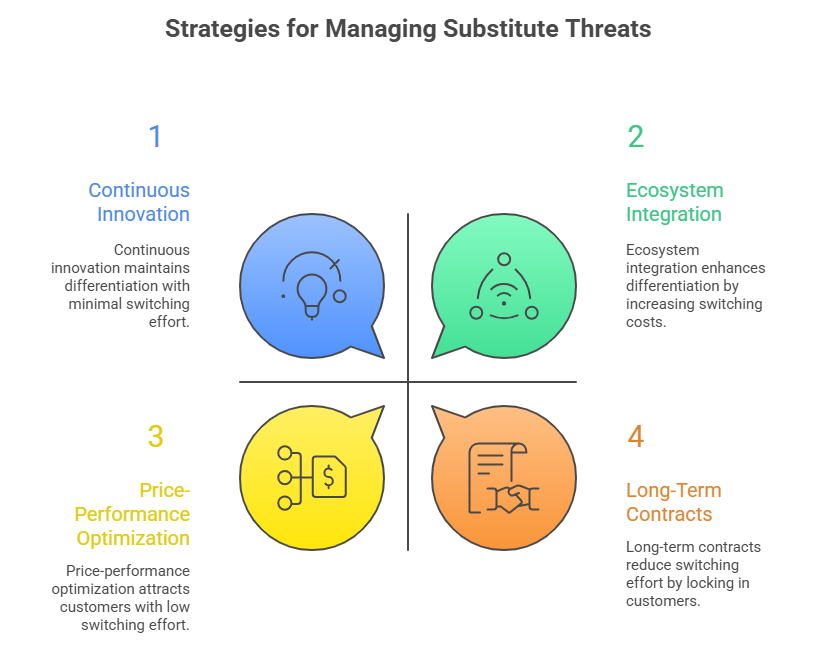
Competing with Substitutes.
The protection strategies are:
- Keep an eye on other competing industries.
- Never stop adding value to retain benefits.
- Keep customers tied up by use of contract, ecosystem or switching cost.
- Be innovative before the substitutes take off.
It is due to the awareness of the threat of substitutes posed by digital delivery that Netflix redefined its offerings and started as a DVD rental service to become a streaming platform.
The use of Porter’s Five Forces: A Practical Framework.
Since you have read about all these forces, here is how to implement this framework:
Step 1: Analyze Each Force.
Strength How strong are the forces in your industry? Also collect information, interview and study the market environment to justify your judgement.
Step 2: Recognize Strategic Implications.
Identify the most significant threats/opportunities developed by the forces. After that, the most important thing is to determine where to concentrate on with your strategy.
Step 3: Develop Action Plans.
Establish certain projects to reinforce your competitive edge in relation to the forces which are adverse and leverage on beneficial ones.
Step 4: Monitor Continuously.
Forces in the industry vary with time. Thus, review your analysis periodically so that you can be ahead of the changes in the competitive dynamics.
Porter’s Five Forces in Action: Applications in reality.
Now, we are going to analyze the ranking of various industries:
| Force | Coffee Shops | Cloud Computing | Pharmaceuticals |
| Competitive Rivalry | High | Moderate | Moderate |
| Threat of New Entrants | Moderate | Low | Very Low |
| Supplier Power | Moderate | Low | Low |
| Buyer Power | High | Moderate | Low |
| Threat of Substitutes | High | Low | Low |
These are just a few examples of the fact that the intensity of force within all industries is so different that it shapes the strategic priorities.
Conclusion: Competitive Strategy: Mastering with Porter’s five forces.
Porters Five Forces is one of the most useful tools to study the competition mechanism and make the strategic decisions. Through competitive analysis, entry barriers, supplier power, customer power, and threat of substitutes, you would have a clear picture of the profit potential and strategic hurdle of your industry.
Keep in mind, it is not only an analysis but action. Use these lessons to distinguish what you offer, develop defensible advantages, and develop sustainable competitive positions. Furthermore, re-examine your analysis on a regular basis because industries change and new forces are coming in.
It is either you are entering a new market, defending or trying to grow your niche, Porters Five Forces gives you the roadmap you require to compete favorably and win.
You are willing to use this framework in your business? Begin by evaluating the forces in your industry to date. Write your commentaries below, or review our related materials on competitive strategy and business planning. These five basic forces are the beginning of the competitive advantage you have been searching.