Business Statistics: Your Complete Guide to Data-Driven Decision Making

Business Statistics: Your Complete Guide to Data-Driven Decision Making

Introduction: Why All Business Leaders Should Have Statistics knowledge.

Imagine the following: You are in a boardroom, in front of executives who are demanding answers. Is it time to introduce that new product? Diversify into another market? Hire more staff? In the absence of data you are just making dart throws in the dark. It is then that statistics will be the key to your arsenal.

Business statistics are not numbers on a spreadsheet in the current competitive business environment, but rather the distinction between companies that succeed and those that only survive. In case of the data-driven organizations, McKinsey research indicates that they are 23 times more likely to be able to get customers and 19 times more likely to get profit. However, there are still many business people who are not that good at utilizing the power of statistical analysis.

This is a complete guide on all you need to know about business statistics starting with the basic concepts up to high-level applications. You can be a startup founder, a marketing manager, or a budding analyst but you will find out how to make raw data actionable in order to achieve actual business outcomes.

What are Business Statistics?

Business statistics is the art of gathering, evaluating, interpreting, and reporting statistics to help in the resolution of business issues and in decision making. Imagine statistics as a GPS system of your company – helping you to make decisions during the times of uncertainty because your gut feelings are not the only way to make a decision.

Fundamentally, business statistics are used to answer such critical questions as:

  • What happened? (Descriptive statistics)
  • Why did it happen? (Diagnostic analytics)
  • What will happen? (Predictive analytics)
  • What should we do? (Prescriptive analytics)
Introduction: Why All Business Leaders Should Have Statistics knowledge.
Imagine the following: You are in a boardroom, in front of executives who are demanding answers. Is it time to introduce that new product? Diversify into another market? Hire more staff? In the absence of data you are just making dart throws in the dark. It is then that statistics will be the key to your arsenal.
Business statistics are not numbers on a spreadsheet in the current competitive business environment, but rather the distinction between companies that succeed and those that only survive. In case of the data-driven organizations, McKinsey research indicates that they are 23 times more likely to be able to get customers and 19 times more likely to get profit. However, there are still many business people who are not that good at utilizing the power of statistical analysis.
This is a complete guide on all you need to know about business statistics starting with the basic concepts up to high-level applications. You can be a startup founder, a marketing manager, or a budding analyst but you will find out how to make raw data actionable in order to achieve actual business outcomes.
What are Business Statistics?
Business statistics is the art of gathering, evaluating, interpreting, and reporting statistics to help in the resolution of business issues and in decision making. Imagine statistics as a GPS system of your company - helping you to make decisions during the times of uncertainty because your gut feelings are not the only way to make a decision.
Fundamentally, business statistics are used to answer such critical questions as:

What happened? (Descriptive statistics)
Why did it happen? (Diagnostic analytics)
What will happen? (Predictive analytics)
What should we do? (Prescriptive analytics)

Employment of statisticians is projected to increase by 33 percent by 2031 by the Bureau of Labor Statistics, much faster than the overall rate, which is a notable indication of the importance of such skills in any industry.
The two Pillars of Business Statistics.
Descriptive Statistics present data in patterns and organize data. Using descriptive statistics, you are counting the average amount that your company is bringing in each month, the median age of your customers, or the sales variance. These scales will give you a picture of your present business reality.
Inferential Statistics go even further because they involve prediction, and conclusions are drawn about the larger populations on the basis of sample data. As an example, when Netflix is experimenting with a new feature on a small scale with 10,000 users, then they are using inferential statistics to reduce risk.
The Reason Business Statistics Are More Important than ever.
There are no more days when business decisions were based on experience and intuition only. The current market world is exact and this is why statistics are becoming inevitable:
Data-driven Competitive Advantage.
Firms using sophisticated analytics have a competitive advantage that is difficult to imitate by their rivals. Harvard Business Review reports that organizations which base their decisions on a data-driven approach are 5-6% more productive and profitable than others. The solution of the Amazon recommendation engine is a complex statistical model that generates nearly one-third of the revenue in the company itself--the effectiveness of statistical applications.
Lessening Risk and smarter Investment.
Any business decision involves risk and statistics can enable you to measure and deal with that risk. To determine the amount of inventory to keep on hand or the marketing channel to give more funds to, statistical analysis can tell you what is likely to happen. This converts risky guesses to strategic moves that are determined.
Customer Knowledge on a Large Scale.
As millions of bits of data are produced every day through visits to websites, purchasing activities and social interactions, statistics offer a framework through which useful patterns can be derived out of this massive amount of data. According to salesforce research, 73 percent of customers want the companies to know about their individual needs, and this is not possible without statistical customer analysis and segmentation.
The most common Statistics in business.
Knowing when and which statistical tools to use is the difference between a competent analyst and a data drowning analyst. It is time to deconstruct the key categories:
Descriptive Statistics: Coming to Terms with the Past.
These statistics create a picture of your present business world through the measures of central tendency and variability.
Measures of Central Tendency determine the value in your data that is typical:

Mean (Average): Sum of all the values divided by the number. Ideal in the cognizance of general performance such as average order value or mean customer lifetime value.
Median: This is the median value on a data set that is sorted in order of value. Better than a mean with outliers such as in computing the common salaries of employees where executive pay may distort means.
Mode: The commonest value. Necessary to inventory management to distinguish the most selling goods or sizes.

Variability Measures indicate the dispersion of your data:

Standard Deviation: Indicates the extent of variation of the values around the mean. Low deviation is consistency; high deviation is volatility - important in quality control and performance monitoring.
Range: The spread between the maximum and minimum values, which provides prompt information on the pricing strategy or productivity changeover.

Inferential Statistics: Future Projections.
Whereas the descriptive statistics provide an answer on what has occurred, inferential statistics provide answers to what is likely to occur next and why.
Hypothesis testing enables you to test the assumptions regarding your business. As an example, can providing a free shipping boost conversion rates? With the use of sample data and statistical tests, you can be confident in the answer and not guessing.
Regression Analysis helps to establish correlations among variables. Linear regression may show the relationship between advertising expenditure and sales growth, whereas multiple regression considers multiple variables at once - such as the relationship between price, advertising and seasonality on revenue.
Confidence Intervals give an interval within which one is likely to find the actual value. You can say we are 95% certain that our conversion rate is in the range of 2.8 to 3.6 instead of saying our conversion rate is 3.2%- it means you have acknowledged uncertainty but you are not being imprecise.
Statistics in the Business: Essentials.
Without practice, theory is meaningless. The following is how major companies apply statistics to spur actual business results:
Customer Analytics and Marketing.
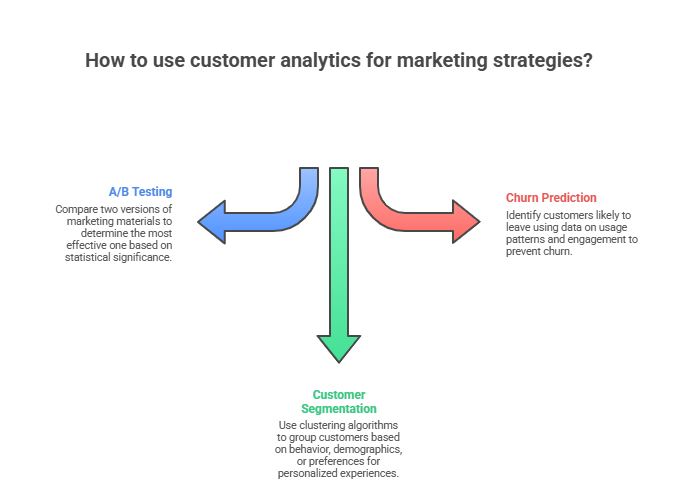
The marketing of the present day operates on the basis of statistics. The A/B testing, which is the comparison of two versions of a webpage or an email, is solely based on the statistical significance testing. Whenever Booking.com is experimenting with button colors or headlines, it is not making a guess as to what will be better, it is making a statistical judgment to prove that differences are not a mere coincidence.
Clustering algorithms are used to segment customers according to their behavior, demographics or preferences in customer segmentation. Epsilon research also claims that 80 percent of consumers most likely to buy when brands provide differentiated experiences and this is not possible without statistical segmentation.
Churn prediction models enable customers who are likely to leave the company to be identified. Using the data on the usage patterns, payment history, and engagement measures, subscription business can act in advance. It is claimed that Netflix employs such models to lower the churn rate and sends personalized content advice to subscribers who are at risk.
Financial Planning and Forecasting.
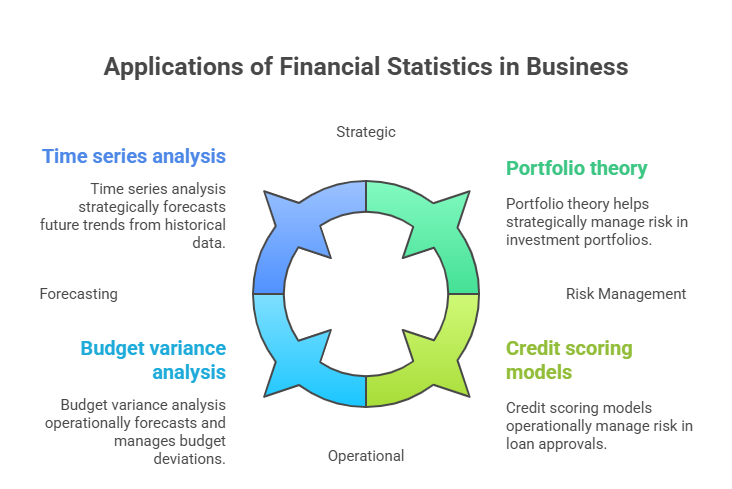
Financial statistics help in the conversion of historical data into future forecasts. The time series analysis is the review of data points registered over time to determine the trends, seasonal variations, and the cyclical movements. This assists the retailers to plan ahead of during a holiday rush or the manufacturers to plan raw material requirements.
In budget variance analysis, actual expenditure is compared with expectations in statistical values. When variances are bigger than anticipated, then it initiates investigation-caught issues at the onset before they develop into crisis.
Probability distributions and statistical modeling play an important role in risk management in finance. The credit scoring models constructed on logistic regression are applied by banks to determine the likelihood of default on a loan, whereas the Portfolio theory is applied by the investment companies to mitigate the risk-return tradeoffs.
The Quality Control and Operations.
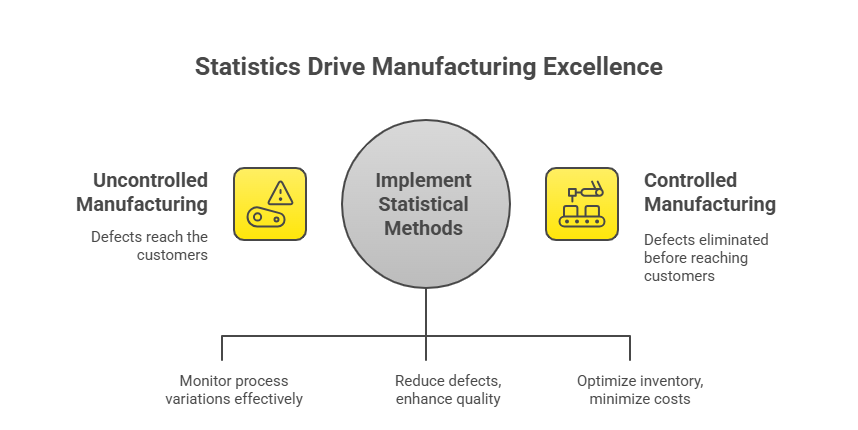
The use of statistical process control (SPC) in manufacturing was an innovation, and it is now applied in all sectors. Through the control charts of monitoring the variations of various processes, companies can know when the performance has gone out of the acceptable limits- eliminating defects before they reach the customers.
The Six Sigma approach used by General Electric and Motorola is molded all around statistical instruments to curb mistakes and enhance quality. The objective: the desired levels of production defects are 99.99766=3.4 defects per million opportunity.
Statistical forecasting of demand determines inventory optimization between the expense of inventory maintenance and the safety of stockouts. The advanced inventory algorithms are based on statistical modeling, which Amazon uses to achieve quick delivery at a minimum of costs in the warehouse, and it is a key strength of the company.
Human Resources Analytics
People analytics uses statistics in management of workforce. Forecasting models can determine who are flight risks in the company, who would succeed in the company, and what motivates engagement.
Deloitte in its Human Capital Trends found that 71 percent of companies prioritize people analytics. Enterprises that leverage HR analytics would record 8 percentage points greater increase in sales and 24 percentage points greater profits than those that use intuition only.
Basic Statistics Every Business Person Must Be Familiar With.
There is no need to be a statistics PhD student to make decisions based on data but becoming proficient in these basic concepts will make your analytical skills exponentially greater:
Correlation vs. Causation
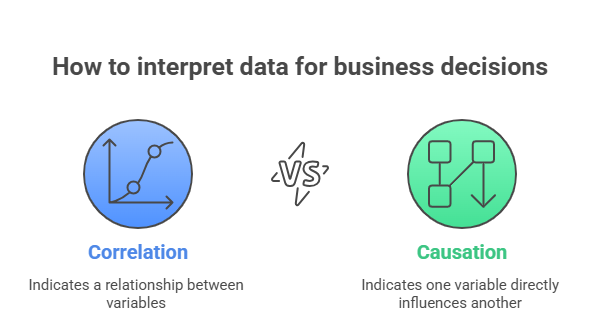
This difference is the cause of failure of many business leaders. The mere fact that two variables shift in the same direction does not imply that one of them causes the other. Ice cream is sold more in summer and drowning deaths are more common in summer, but it is the temperature that is common to both.
You may come across in business that those companies who have free snacks generate more income. Is this by offering snacks that leads to an increase in revenue? Not necessarily. In fact, it is probably that only successful and profitable companies can afford such perks as free snacks. The knowledge of this difference will avoid expensive errors in terms of spurious correlations.
Statistical Significance
In the analysis of results, you must understand whether the difference is meaningful or it is the noise. An increase in conversion rates by 2% is wonderful but is it statistically significant or is it within a normal range?
The p-value is used to address this question. Generally, a threshold of 0.05 is used by researchers which indicates that there is a less than five percent chance that the results have been obtained by chance. Nevertheless, statistical significance does not imply that the statistically significant 0.01 percent improvement is meaningful in practice- maybe its worth is less than the cost of the implementation.
Sample Size and Margin of error.
Then you want to know what customers are satisfied with, but you are not able to survey all. Statistics will give you the number of responses that you require to reach sound conclusions. Greater sample sizes minimise your margin of error, but at a certain point the reduction is diminishing.
To illustrate, a survey of 100 customers could provide you with +-10 percent margin of error, 95 percent, and 400 surveys will reduce it to +-5. The correlation is not linear - doubling your sample means only reducing your margin of error by half.
Normal Distribution
Numerous business measures are normal distributed--two extremes are less common than the mean value. This is important since most of the statistical tests are based on the assumption of normal distribution. You have to have other methods of analysis when the data is not normally distributed.
Knowledge of distribution assists in the selection of suitable metrics. With extremely skewed data such as household income, median is more informative than mean because a small group of the ultra-high earners incredibly exaggerate the average.
Introduction to Business Statistics: How to Start.
You are about to apply statistical thinking in your organization? Here's your roadmap:
Step 1: State Chronic Business Queries.
The meaningless statistics is merely math. Begin by stating certain decisions or problems: Should we launch this product? Which customer group are we supposed to target? Why is the rate of cart abandonment high?
Turn these into quantifiable questions and an objective measure of success. Increase sales is not a specific action, so you can get something specific to increase your sales in the form of increase average order value by 15 percent in six months.
Step 2: Collect Quality Data
Garbage in, garbage out. As good as your data is so is your statistical analysis. Introduction of mechanisms to record relevant information regularly, be it by CRM software, Google Analytics, point-of-sale system, or surveys of customer.
Gartner research found that low quality of data costs the organizations an average of 12.9 million dollars a year. Invest in data hygiene: clean, standardised and validated data is a dividend in the accuracy of analysis.
Step 3: Select the Right Tools.
You do not even require a costly software to begin with. Excel also has remarkably good statistical functionality in simpler analysis. As you proceed, you may consider such tools as:

Excel: Descriptive statistics, simple graphs, and simple regression analysis are all good in Excel.
Google Analytics: This is necessary to know the performance of the website.
Tableau or power BI: Enterprise visualization and intelligence.
R or Python: Efficient statistical computing of data scientists.
SPSS or SAS: Statistical software of professional quality to analyze complicated data.
Step 4: Results Analysis and Interpretation.
Run your statistical tests, but bear in mind, numbers do not speak. Context matters enormously. A 50 percent month-on-month growth in revenues is something to celebrate till you notice that it is December to January in a period when the holiday season is in a slump.
Always question: What does this mean to our business? So what are we supposed to do according to these findings? To what extent are we sure of such conclusions?
Step 5: Share Insights in an effective manner.
No good analysis is useless unless it is interpreted and put into action by the stakeholders. Put statistics into business words. Rather than stating that the p-value is 0.03, state that we are 97 percent sure that this marketing campaign brought about huge sales growth.
Make complex data available with the help of visualization, charts, graphs, and infographics. Research indicates that individuals remember visual data 65 percent as compared to when using text alone.
Common Pitfalls to Avoid
The mistakes are made even by the experienced analysts. Consciousness will make you avoid them:
Over-Relying on Averages
Means conceal significant information. Five employees make 40,000 and one makes 200,000, the average salary would be 66,667 which is misleading to both sides. Never consider only the mean of the distribution but also the entire distribution.
Ignoring Sample Bias
You will come up with biased data in case you survey only your best customers as to whether they are satisfied or not. Make sure your samples reflect on the population you are studying. There is the problem of selection bias in online reviews where dissatisfied customers are more likely to leave a review.
Mixing Precision and Accuracy.
Recording revenue to the nearest one hundredth place will be accurate, yet in case your accounting system contains systematic errors then the accurate numbers will be inaccurate. Put attention on accuracy then precision second.
Analysis Paralysis
Statistical information brings in interminable understanding but you have to decide at some stage. Establish moderate levels of confidence and time. In business, perfect information is an unattainable concept- good enough is frequently better than perfect.
Future of Business Statistics.
The statistical analysis is being revolutionized by artificial intelligence and machine learning. Algorithms that took weeks to be processed and PhDs now happen in seconds using automated algorithms. Nevertheless, judgment of a human being cannot be replaced.
Predictive analytics will be common in all business functions. As postulated by Forrester research, by 2025, insights-driven businesses will win a share of about 1.8 trillion of annual revenues- taking over the market share of the competitors who dismiss the importance of the data.
Real-time analytics allow making decisions in real-time. Retailers are dynamically pricing depending on demand and advertisers automatic optimization of campaigns on the basis of the performance statistics. It is not whether to implement these tools, but how fast can you do it.
Democratization of analytics implies that the access of the statistical tools by non-technical employees becomes more common. It is possible to query things such as What were sales trends last quarter, with Natural language processing. and getting live statistics visualizations- no coding needed.
Major Findings: Statistics in Action.
Statistical ConceptBusiness ApplicationExpected ImpactA/B TestingOptimize conversion rates of websites10-30% higher conversion ratesRegression AnalysisPredict sales based on many factors+-5-10% error reduction in prediction Customer SegmentationTargeted marketing campaigns20-30% more conversion rate Control ChartsMonitor quality process50-70% fewer defects Time Series Analysis Planning inventory and demand15-25% less stockouts
Finding: Your Statistical Journey Begins Now.
Business statistics are easy to swallow into small pieces and easy to apply into practice. These tools are capable of intelligent, quicker, and more assured decision-making, whether it involves knowing your present state of performance with descriptive statistics or forecasting your future with inferential statistics.
The reason is that the companies that are at the top of their industries Amazon, Netflix, Google and the list of those who have adopted data-driven decision-making that is data-driven is long. They don't guess; they know. They don't hope; they predict. They do not respond, they look ahead.
You do not have to join the ranks of statisticians overnight. Begin small: compute important business measurements, do simple A/B tests, or customer segment. Every step makes you a more statistical person and uncovers opportunities your competitors could have overlooked.
Its data is already in it, it is just a matter of letting it tell its story. Finally, with statistical tools you can now listen, understand and act. The question is, will you be left behind or will you leverage these insights to put an end to your competition, which is already doing it?
Are you willing to make your business choices statistical? To start with, locate one burning question within your organization at this time and use the statistical techniques that we have covered to discover your solution. Post your findings in the comments section below or visit our data analytics library to learn more. The future of business is data driven not arriving in the future.
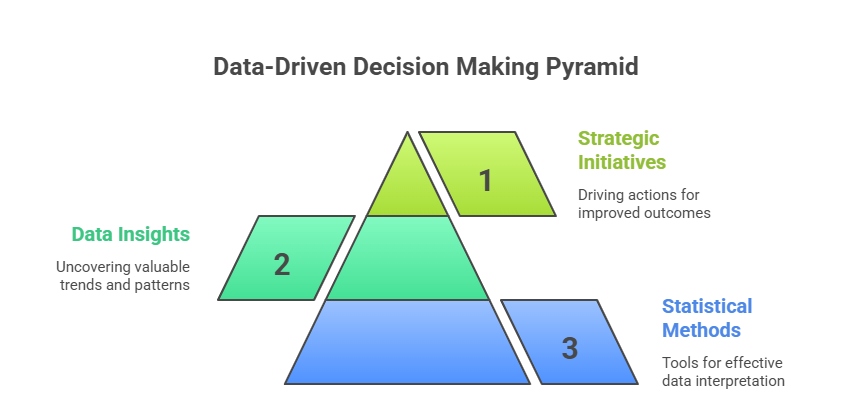
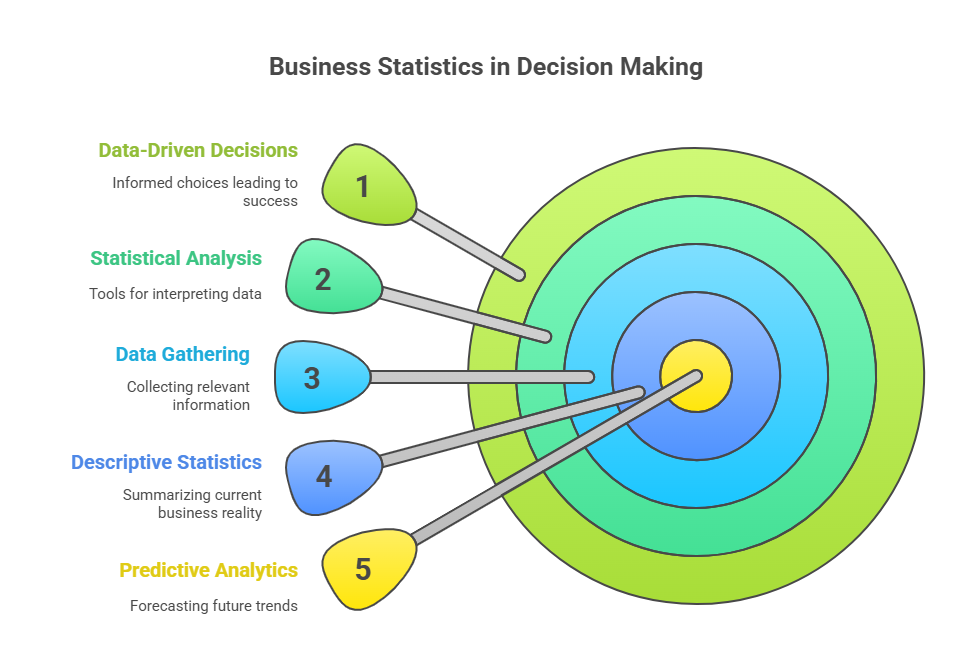
Business Statistics in Decision Making

The two Pillars of Business Statistics.

Descriptive Statistics present data in patterns and organize data. Using descriptive statistics, you are counting the average amount that your company is bringing in each month, the median age of your customers, or the sales variance. These scales will give you a picture of your present business reality.

Inferential Statistics go even further because they involve prediction, and conclusions are drawn about the larger populations on the basis of sample data. As an example, when Netflix is experimenting with a new feature on a small scale with 10,000 users, then they are using inferential statistics to reduce risk.

The Reason Business Statistics Are More Important than ever.

There are no more days when business decisions were based on experience and intuition only. The current market world is exact and this is why statistics are becoming inevitable:

Business Statistics_ Your Complete Guide to Data-Driven Decision Making - visual selection
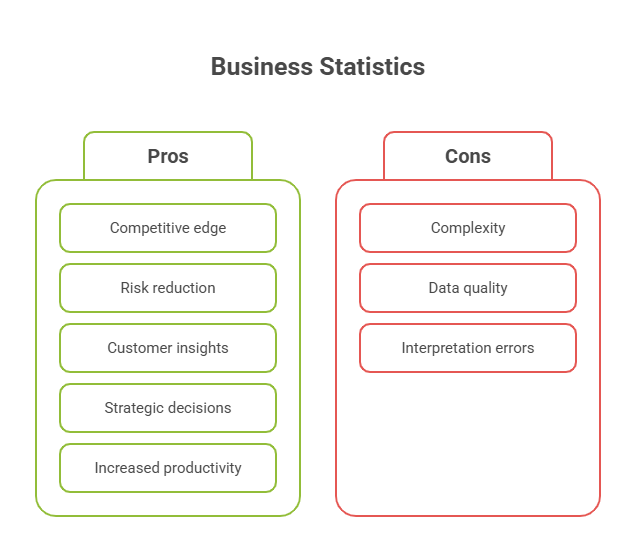
Pros and Cons in Business Statistics

Data-driven Competitive Advantage.

Firms using sophisticated analytics have a competitive advantage that is difficult to imitate by their rivals. Harvard Business Review reports that organizations which base their decisions on a data-driven approach are 5-6% more productive and profitable than others. The solution of the Amazon recommendation engine is a complex statistical model that generates nearly one-third of the revenue in the company itself–the effectiveness of statistical applications.

Lessening Risk and smarter Investment.

Any business decision involves risk and statistics can enable you to measure and deal with that risk. To determine the amount of inventory to keep on hand or the marketing channel to give more funds to, statistical analysis can tell you what is likely to happen. This converts risky guesses to strategic moves that are determined.

Customer Knowledge on a Large Scale.

As millions of bits of data are produced every day through visits to websites, purchasing activities and social interactions, statistics offer a framework through which useful patterns can be derived out of this massive amount of data. According to salesforce research, 73 percent of customers want the companies to know about their individual needs, and this is not possible without statistical customer analysis and segmentation.

The most common Statistics in business.

Knowing when and which statistical tools to use is the difference between a competent analyst and a data drowning analyst. It is time to deconstruct the key categories:

Descriptive Statistics: Coming to Terms with the Past.

These statistics create a picture of your present business world through the measures of central tendency and variability.

Measures of Central Tendency determine the value in your data that is typical:

Mean (Average): Sum of all the values divided by the number. Ideal in the cognizance of general performance such as average order value or mean customer lifetime value.

Median: This is the median value on a data set that is sorted in order of value. Better than a mean with outliers such as in computing the common salaries of employees where executive pay may distort means.

Mode: The commonest value. Necessary to inventory management to distinguish the most selling goods or sizes.

Variability Measures indicate the dispersion of your data:

Standard Deviation: Indicates the extent of variation of the values around the mean. Low deviation is consistency; high deviation is volatility – important in quality control and performance monitoring.

Range: The spread between the maximum and minimum values, which provides prompt information on the pricing strategy or productivity changeover.

Inferential Statistics: Future Projections.

Whereas the descriptive statistics provide an answer on what has occurred, inferential statistics provide answers to what is likely to occur next and why.

Hypothesis testing enables you to test the assumptions regarding your business. As an example, can providing a free shipping boost conversion rates? With the use of sample data and statistical tests, you can be confident in the answer and not guessing.

Regression Analysis helps to establish correlations among variables. Linear regression may show the relationship between advertising expenditure and sales growth, whereas multiple regression considers multiple variables at once – such as the relationship between price, advertising and seasonality on revenue.

Confidence Intervals give an interval within which one is likely to find the actual value. You can say we are 95% certain that our conversion rate is in the range of 2.8 to 3.6 instead of saying our conversion rate is 3.2%- it means you have acknowledged uncertainty but you are not being imprecise.

Statistics in the Business: Essentials.

Without practice, theory is meaningless. The following is how major companies apply statistics to spur actual business results:

Customer Analytics and Marketing.

The marketing of the present day operates on the basis of statistics. The A/B testing, which is the comparison of two versions of a webpage or an email, is solely based on the statistical significance testing. Whenever Booking.com is experimenting with button colors or headlines, it is not making a guess as to what will be better, it is making a statistical judgment to prove that differences are not a mere coincidence.

Clustering algorithms are used to segment customers according to their behavior, demographics or preferences in customer segmentation. Epsilon research also claims that 80 percent of consumers most likely to buy when brands provide differentiated experiences and this is not possible without statistical segmentation.

Churn prediction models enable customers who are likely to leave the company to be identified. Using the data on the usage patterns, payment history, and engagement measures, subscription business can act in advance. It is claimed that Netflix employs such models to lower the churn rate and sends personalized content advice to subscribers who are at risk.

Business Statistics_ Your Complete Guide to Data-Driven Decision Making - visual selection
Application in Marketing

Financial Planning and Forecasting.

Financial statistics help in the conversion of historical data into future forecasts. The time series analysis is the review of data points registered over time to determine the trends, seasonal variations, and the cyclical movements. This assists the retailers to plan ahead of during a holiday rush or the manufacturers to plan raw material requirements.

In budget variance analysis, actual expenditure is compared with expectations in statistical values. When variances are bigger than anticipated, then it initiates investigation-caught issues at the onset before they develop into crisis.

Probability distributions and statistical modeling play an important role in risk management in finance. The credit scoring models constructed on logistic regression are applied by banks to determine the likelihood of default on a loan, whereas the Portfolio theory is applied by the investment companies to mitigate the risk-return tradeoffs.

Business Statistics_ Your Complete Guide to Data-Driven Decision Making - visual selection
Application in Statistics in Financial Planning

The Quality Control and Operations.

The use of statistical process control (SPC) in manufacturing was an innovation, and it is now applied in all sectors. Through the control charts of monitoring the variations of various processes, companies can know when the performance has gone out of the acceptable limits- eliminating defects before they reach the customers.

The Six Sigma approach used by General Electric and Motorola is molded all around statistical instruments to curb mistakes and enhance quality. The objective: the desired levels of production defects are 99.99766=3.4 defects per million opportunity.

Statistical forecasting of demand determines inventory optimization between the expense of inventory maintenance and the safety of stockouts. The advanced inventory algorithms are based on statistical modeling, which Amazon uses to achieve quick delivery at a minimum of costs in the warehouse, and it is a key strength of the company.

Business Statistics_ Your Complete Guide to Data-Driven Decision Making - visual selection
Application of Statistics in Manufacturing.

Human Resources Analytics.

People analytics uses statistics in management of workforce. Forecasting models can determine who are flight risks in the company, who would succeed in the company, and what motivates engagement.

Deloitte in its Human Capital Trends found that 71 percent of companies prioritize people analytics. Enterprises that leverage HR analytics would record 8 percentage points greater increase in sales and 24 percentage points greater profits than those that use intuition only.

Basic Statistics Every Business Person Must Be Familiar With.

There is no need to be a statistics PhD student to make decisions based on data but becoming proficient in these basic concepts will make your analytical skills exponentially greater:

Correlation vs. Causation

This difference is the cause of failure of many business leaders. The mere fact that two variables shift in the same direction does not imply that one of them causes the other. Ice cream is sold more in summer and drowning deaths are more common in summer, but it is the temperature that is common to both.

You may come across in business that those companies who have free snacks generate more income. Is this by offering snacks that leads to an increase in revenue? Not necessarily. In fact, it is probably that only successful and profitable companies can afford such perks as free snacks. The knowledge of this difference will avoid expensive errors in terms of spurious correlations.

Business Statistics_ Your Complete Guide to Data-Driven Decision Making - visual selection
Correlation and Cohesion

Statistical Significance.

In the analysis of results, you must understand whether the difference is meaningful or it is the noise. An increase in conversion rates by 2% is wonderful but is it statistically significant or is it within a normal range?

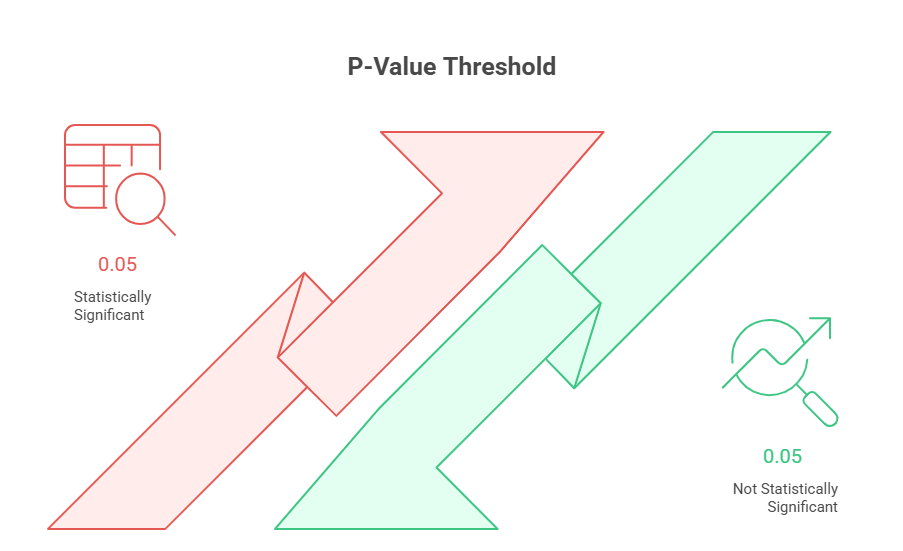
The p-value is used to address this question. Generally, a threshold of 0.05 is used by researchers which indicates that there is a less than five percent chance that the results have been obtained by chance. Nevertheless, statistical significance does not imply that the statistically significant 0.01 percent improvement is meaningful in practice- maybe its worth is less than the cost of the implementation.

Sample Size and Margin of error.

Statistics will give you the number of responses that you require to reach sound conclusions. Greater sample sizes minimize the margin of error, but at a certain point the reduction is diminishing.

To illustrate, a survey of 100 customers could provide you with +-10 percent margin of error, 95 percent, and 400 surveys will reduce it to +-5. The correlation is not linear – doubling your sample means only reducing your margin of error by half.
Business Statistics_ Your Complete Guide to Data-Driven Decision Making - visual selection
P Value

Normal Distribution.

Numerous business measures are normal distributed–two extremes are less common than the mean value. This is important since most of the statistical tests are based on the assumption of normal distribution.

Knowledge of distribution assists in the selection of suitable metrics. With extremely skewed data such as household income, median is more informative than mean because a small group of the ultra-high earners incredibly exaggerate the average.

Introduction to Business Statistics: How to Start.

You are about to apply statistical thinking in your organization? Here’s your roadmap:

Step 1: State Chronic Business Queries.

The meaningless statistics is merely math. Begin by stating certain decisions or problems: Should we launch this product? Why is the rate of cart abandonment high?

Turn these into quantifiable questions and an objective measure of success. Increase sales is not a specific action, so you can get something specific to increase your sales in the form of increase average order value by 15 percent in six months.

Step 2: Collect Quality Data.

Garbage in, garbage out. As good as your data is so is your statistical analysis. Introduction of mechanisms to record relevant information regularly, be it by CRM software, Google Analytics, point-of-sale system, or surveys of customer.

Gartner research found that low quality of data costs the organizations an average of 12.9 million dollars a year. Invest in data hygiene: clean, standardised and validated data is a dividend in the accuracy of analysis.

Step 3: Select the Right Tools.

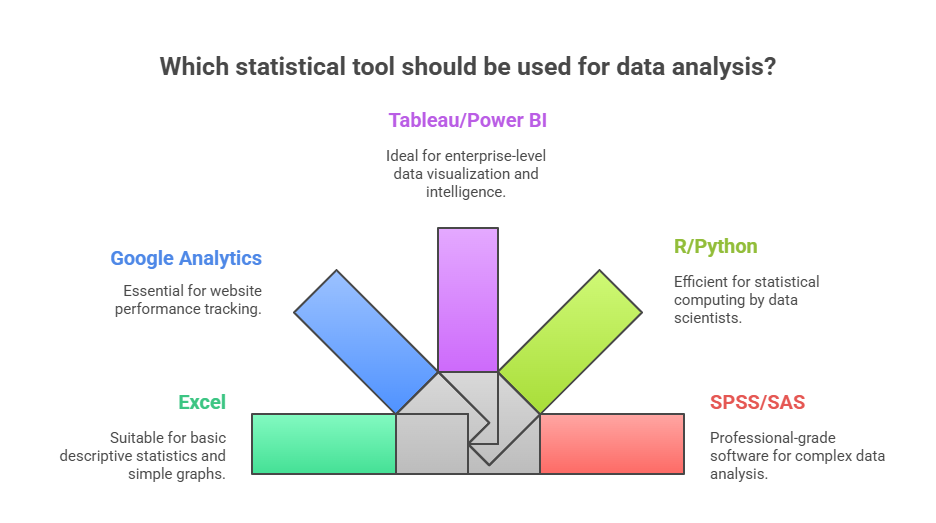
You do not even require a costly software to begin with. Excel also has remarkably good statistical functionality in simpler analysis. As you proceed, you may consider such tools as:

Excel: Descriptive statistics, simple graphs, and simple regression analysis are all good in Excel.

Google Analytics: This is necessary to know the performance of the website.

Tableau or power BI: Enterprise visualization and intelligence.

R or Python: Efficient statistical computing of data scientists.

SPSS or SAS: Statistical software of professional quality to analyze complicated data.
Business Statistics_ Your Complete Guide to Data-Driven Decision Making - visual selection (8)
Statistical Analysis Tools

Step 4: Results Analysis and Interpretation.

Run your statistical tests, but bear in mind, numbers do not speak. Context matters enormously. A 50 percent month-on-month growth in revenues is something to celebrate till you notice that it is December to January in a period when the holiday season is in a slump.

Always question: What does this mean to our business? To what extent are we sure of such conclusions?

Step 5: Share Insights in an effective manner.

Apply statistics into business words. Rather than stating that the p-value is 0.03, state that we are 97 percent sure that this marketing campaign brought about huge sales growth.

Make complex data available with the help of visualization, charts, graphs, and infographics. Research indicates that individuals remember visual data 65 percent as compared to when using text alone.

Common Pitfalls to Avoid.

The mistakes are made even by the experienced analysts. Consciousness will make you avoid them:

Over-Relying on Averages.

Means conceal significant information. Five employees make 40,000 and one makes 200,000, the average salary would be 66,667 which is misleading to both sides. Never consider only the mean of the distribution but also the entire distribution.

Ignoring Sample Bias.

Make sure the samples reflect on the population you are studying. There is the problem of selection bias in online reviews where dissatisfied customers are more likely to leave a review.

Mixing Precision and Accuracy.

Recording revenue to the nearest one hundredth place will be accurate, yet in case your accounting system contains systematic errors then the accurate numbers will be inaccurate. Put attention on accuracy then precision second.

Analysis Paralysis.

Statistical information brings in interminable understanding but you have to decide at some stage. Establish moderate levels of confidence and time. In business, perfect information is an unattainable concept- good enough is frequently better than perfect.

Future of Business Statistics.

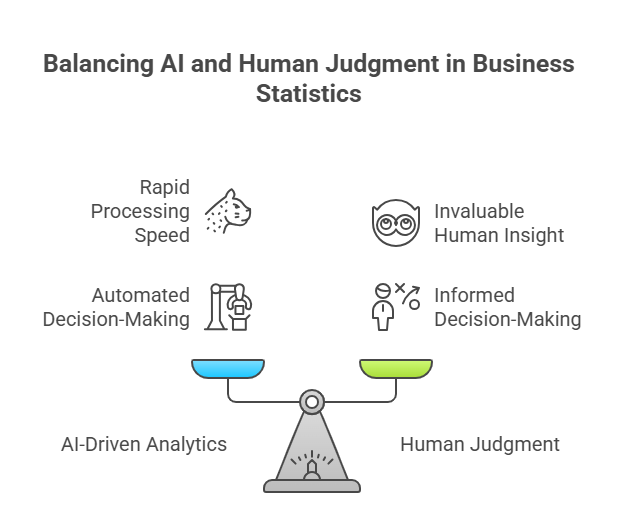
The statistical analysis has being revolutionized by artificial intelligence and machine learning. Algorithms that took weeks to be processed and PhDs now happen in seconds using automated algorithms. Nevertheless, judgment of a human being cannot be replaced.

Predictive analytics will be common in all business functions. As postulated by Forrester research, by 2025, insights-driven businesses will win a share of about 1.8 trillion of annual revenues- taking over the market share of the competitors who dismiss the importance of the data.

Real-time analytics allow making decisions in real-time. Retailers are dynamically pricing depending on demand and advertisers automatic optimization of campaigns on the basis of the performance statistics. It is not whether to implement these tools, but how fast can you do it.

Democratization of analytics implies that the access of the statistical tools by non-technical employees becomes more common. It is possible to query things such as What were sales trends last quarter, with Natural language processing. and getting live statistics visualizations- no coding needed.
Business Statistics_ Your Complete Guide to Data-Driven Decision Making - visual selection
Future in Business Statistics

Major Findings: Statistics in Action.

Statistical ConceptBusiness ApplicationExpected Impact
A/B TestingOptimize website conversion rates10-30% improvement in conversions
Regression AnalysisForecast sales based on multiple factors±5-10% accuracy in predictions
Customer SegmentationPersonalize marketing campaigns20-30% increase in campaign ROI
Control ChartsMonitor process quality50-70% reduction in defects
Time Series AnalysisInventory and demand planning15-25% reduction in stockouts

Conclusion.

Business statistics are easy to swallow into small pieces and easy to apply into practice. These tools are capable of intelligent, quicker, and more assured decision-making, whether it involves knowing your present state of performance with descriptive statistics or forecasting your future with inferential statistics.

The reason is that the companies that are at the top of their industries Amazon, Netflix, Google and the list of those who have adopted data-driven decision-making that is data-driven is long. They don’t guess; they know. Also don’t hope; they predict. Finally do not respond, they look ahead.

You do not have to join the ranks of statisticians overnight. Begin small: compute important business measurements, do simple A/B tests, or customer segment. Every step makes you a more statistical person and uncovers opportunities your competitors could have overlooked.

Its data is already in it, it is just a matter of letting it tell its story. Finally, with statistical tools you can now listen, understand and act.

Are you willing to make your business choices statistical? To start with, locate one burning question within your organization at this time and use the statistical techniques that we have covered to discover your solution. Post your findings in the comments section below or visit our data analytics library to learn more.

Power Up Your Business Mindset !

Subscribe for fresh business insights, smart strategies, and industry updates direct to your inbox.

Comments

No comments yet. Why don’t you start the discussion?

Leave a Reply

Your email address will not be published. Required fields are marked *